The map is difficult to ignore.
It places bonds, construction loans, private placements, asset-backed finance, cloud contracts, chip suppliers, model companies, hyperscalers, guarantees, leases and equity investments into one dense web. OpenAI, Anthropic, NVIDIA, Oracle, Microsoft, Amazon, Google, Meta, CoreWeave and others appear not as independent actors, but as counterparties whose commitments increasingly touch one another.
For a CTO, the immediate interpretation is tempting: if the AI buildout is being supported by circular financing, today’s low-cost access to ChatGPT and Claude may be temporary. When investors demand returns, capital tightens, or infrastructure commitments come due, model prices could rise dramatically.
That scenario is possible. It is not the only plausible one.
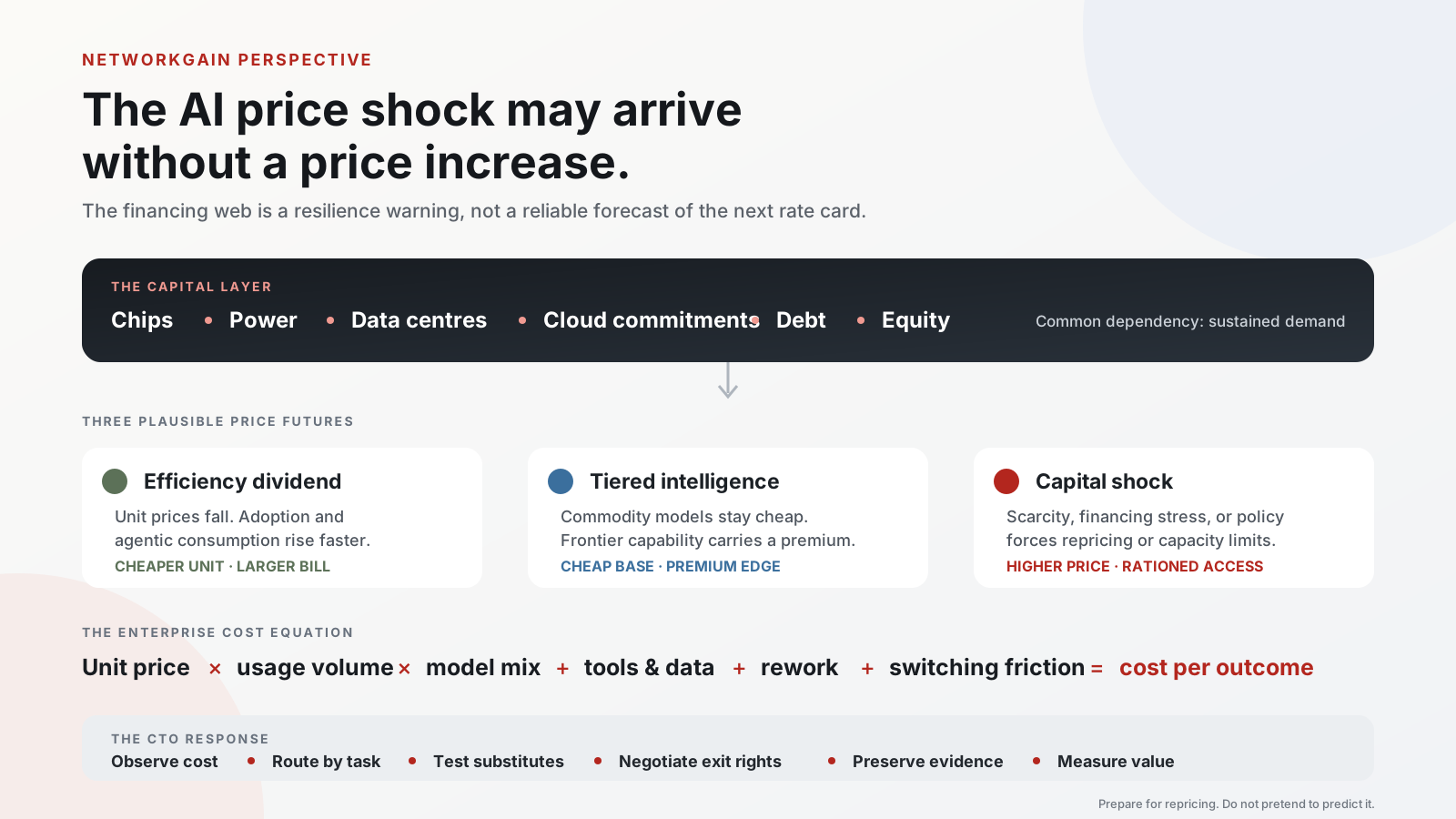
The stronger conclusion is more useful: the financing web is a resilience warning, not a reliable forecast of the next rate card. CTOs should prepare for AI repricing without pretending to know whether the shock will arrive through higher token prices, premium capability, capacity rationing, changing contract terms—or simply far more usage at prices that continue to fall.
The risk is not only that ChatGPT or Claude becomes more expensive.
The risk is that the enterprise builds an operating model in which it cannot absorb any change in the economics of intelligence.
What the financing map actually tells us
The supplied Ares Alternative Credit exhibit maps 32 financings across eight named counterparties. Its most important phrase appears at the bottom: common dependency—sustained AI capital spending.
That is a legitimate signal. Frontier AI is not a weightless software market. It depends on semiconductors, networking, land, power, cooling, data centres, construction capacity, cloud contracts and long-duration capital. The 2026 Stanford AI Index describes both record investment and rapidly growing compute expenditure. OpenAI’s Stargate announcement set out an intended $500 billion infrastructure programme involving equity funders, cloud providers and chip partners. Anthropic’s expanded AWS partnership combined an $8 billion minority investment with a primary cloud and training relationship.
These relationships matter because risk can travel across them. A financing constraint at a data-centre operator can affect capacity. A weaker off-taker can affect an asset-backed structure. A delayed power project can affect cloud availability. A shift in chip economics can alter model-serving costs. Counterparties that appear diversified may still depend on the same underlying assumption: demand for AI capacity will continue to grow quickly enough to justify the buildout.
But interconnected is not the same as circular, and circular is not automatically unsustainable.
Industrial systems have always involved suppliers financing customers, customers making purchase commitments, infrastructure owners leasing capacity, and strategic partners taking equity positions. Railways, telecom networks, energy systems, aircraft and cloud computing all developed through webs of capital and long-term contracts. These arrangements can distribute risk, accelerate capacity and match long-lived assets with long-lived demand.
The map also combines instruments with different legal rights, maturities, collateral and risk positions. A corporate bond is not the same as a purchase commitment. A lease is not the same as an equity investment. A guarantee is not the same as cash already spent. Drawing lines between them reveals concentration, but does not by itself establish fragility or mispricing.
The figure should therefore change a CTO’s posture—not dictate a market prediction.
The case for a material AI price increase
There are credible reasons to prepare for higher prices.
Capital eventually asks to be paid
The physical buildout is enormous. Debt requires interest and repayment. Equity expects a return. Infrastructure must achieve utilisation. If adoption or monetisation grows more slowly than the commitments made in anticipation of it, providers may have to protect margins through price increases, tighter allowances, reserved-capacity charges, minimum commitments or more aggressive segmentation.
Low prices are not proof that the fully loaded economics are already reflected in the product. They may also reflect a market-share phase in which providers prioritise adoption, developer mindshare and workload capture.
Frontier capacity can remain scarce even when average compute becomes cheaper
The market does not sell one homogeneous unit called “AI.” Commodity summarisation and classification may become inexpensive while the best reasoning, coding, research, multimodal or cyber capabilities remain capacity constrained. Power, advanced packaging, high-bandwidth memory, networking and permitted data-centre sites can create bottlenecks that do not disappear at the pace of model innovation.
In such a market, basic intelligence can keep getting cheaper while frontier intelligence becomes a premium utility.
Pricing can rise without a headline increase
Both OpenAI and Anthropic already price different service characteristics differently. Long context, higher-speed processing, regional processing, cache writes, model tiers, tool use and output tokens can carry different rates or multipliers. Enterprise agreements can add seat fees, commitments, usage charges and overages.
A provider does not need to triple a familiar subscription price to reprice the service. It can change included allowances, move the most valuable capability to a higher tier, charge separately for agentic work, alter rate limits, retire an economical model, or make low-latency and data-resident processing premium features.
For an enterprise, the effective increase can be dramatic even when the public price page looks stable.
Lock-in creates pricing power
An application tightly coupled to one provider’s prompts, tool schemas, safety behaviour, memory, retrieval stack, fine-tuning method and evaluation assumptions is not portable merely because it calls an API.
The deeper the operational dependency, the harder it is to respond to a price change. Migration requires more than replacing a model name. Outputs change. Failure modes change. Tests may no longer pass. Risk approvals may need to be repeated. Users may experience different behaviour. The cost of switching becomes part of the provider’s pricing power.
This is the strongest reason for CTOs to act before any price increase occurs.
The case against the price-shock thesis
There are equally credible reasons not to assume that ChatGPT and Claude will simply become much more expensive.
The long-run direction of inference economics has been downward
The Stanford AI Index 2025 found that the cost of querying a model at roughly GPT-3.5-level performance fell more than 280-fold between November 2022 and October 2024. Smaller models became materially more capable. Caching, quantisation, batching, speculative decoding, better serving software and improved hardware continue to reduce the cost of useful inference.
New frontier models may command high prices, but yesterday’s frontier tends to become tomorrow’s economical tier.
Competition limits pricing power
OpenAI and Anthropic compete with Google, Meta, xAI, Mistral, DeepSeek, cloud-hosted models, open-weight ecosystems and specialised models. Enterprises can increasingly access the same model through more than one commercial channel. Anthropic, for example, states that Claude is available across AWS, Google Cloud and Microsoft. Open standards and model gateways are reducing some integration friction.
Competition does not eliminate lock-in, but it makes broad, sustained price increases harder when substitutes are good enough for a large share of workloads.
Providers need utilisation as much as customers need intelligence
Infrastructure economics improve when expensive capacity is used. Lower prices can expand demand, improve utilisation and create new workloads. Providers also gain when customers move from occasional chat to embedded, recurring, agentic use.
This creates a powerful incentive to pass at least part of efficiency gains to the market. A provider can earn more even as the price per token falls—if consumption grows faster.
The buildout itself can lower cost
Vertical integration, custom silicon, diversified cloud partnerships and co-designed serving systems are not only financial complexity. They are attempts to reduce supply risk and unit cost. OpenAI argues that greater efficiency and broader infrastructure partnerships can lower the cost of delivering intelligence over time. Anthropic’s work with AWS Trainium is explicitly framed around price-performance and scale.
The financing web can therefore be read in two ways: as a concentration of correlated obligations, or as the capital formation needed to make intelligence abundant.
Both readings can be true at once.
The price per token is not the enterprise bill
The debate becomes clearer when the unit of analysis changes.
ChatGPT and Claude are not single prices. They are portfolios of consumer subscriptions, enterprise seats, API tokens, cloud marketplace purchases, reserved capacity, premium models, tools, searches, storage, data movement, regional processing and agentic work.
The enterprise cost equation is closer to:
Unit price × usage volume × model mix + tools and data + retries and rework + control overhead + switching friction = cost per trusted outcome
This explains how all three of the following can happen simultaneously:
- the price per token falls;
- employees and agents consume far more tokens, tools and context; and
- the enterprise AI bill rises sharply.
Agentic systems amplify this effect. A person sees one completed task. Behind it, the system may plan, search, call tools, load context, generate, critique, retry, test and escalate across several models. A cheaper model can make each step less expensive while making it economical to run many more steps.
The CTO who negotiates a lower token rate but cannot see task-level consumption has not controlled cost. The CTO who chooses the cheapest model but creates more rework has not created value. The CTO who standardises on one provider for convenience but cannot test a substitute has converted a technology choice into an unpriced financial exposure.
The governing measure should be cost per trusted outcome, not cost per token.
Three futures deserve one resilient response
No planning team needs to bet the architecture on a single forecast. Three scenarios are plausible.
1. The efficiency dividend
Unit prices continue to decline as hardware, models and serving improve. Adoption expands even faster. The risk is not a rate shock but uncontrolled volume: agents proliferate, context grows, and consumption becomes invisible inside business workflows.
2. Tiered intelligence
Routine intelligence becomes abundant and inexpensive. The most capable, fastest, safest, most sovereign or most specialised services carry substantial premiums. The risk is poor workload placement: the enterprise uses frontier capability for work that a smaller model, decision model or deterministic system could perform.
3. The capital shock
Financing stress, supply constraints, energy limits, policy changes or insufficient demand force providers to reprice, ration capacity or renegotiate commitments. The risk is architectural and commercial dependence: important workflows cannot move, degrade gracefully or operate within a new budget.
The response is similar in every case. Build observability, workload choice, tested substitutes, commercial protections and decision discipline before the market selects the scenario.
What CTOs should do now
Preparation does not require an anti-vendor strategy. It requires an anti-fragile operating model.
Map economic dependency by business outcome
Start with the workflows that matter, not a vendor inventory. For each outcome, identify the models, tools, clouds, data services, prompts, context, evaluation logic and human review on which it depends. Separate convenience workloads from revenue, regulatory, customer and operationally critical workloads.
This reveals where repricing would be irritating and where it would be consequential.
Instrument cost at the task and outcome level
Track model, input, output, cached context, tool calls, searches, retries, latency tier and human rework. Connect that consumption to a completed business or engineering outcome. A monthly provider invoice is too late and too aggregated to guide architecture.
Route work by need, not habit
Use a portfolio of frontier, mid-tier, small, specialised and deterministic systems. Reserve premium intelligence for work that demonstrably benefits from it. Use caching, batching and bounded context where they improve economics. Make model choice a policy informed by evidence, not a preference embedded in every application.
Maintain a tested substitution path
An abstraction layer is not enough. Regularly run representative workloads against alternatives. Compare quality, latency, safety, cost and operational behaviour. Preserve evaluation sets and acceptance thresholds. Know which capabilities are genuinely provider-specific and which can move.
Portability that has never been exercised is documentation, not resilience.
Negotiate the exit before scale creates dependence
Commercial terms should address price protection, volume bands, notice for model retirement, data portability, service-level expectations, capacity priority, regional processing, auditability, minimum commitments and termination assistance. Procurement, architecture, security, finance and legal teams need one shared view of the exposure.
Govern proliferation
The greatest cost shock may come from hundreds of locally sensible deployments accumulating into an enterprise-wide liability. Establish a model catalogue, approved patterns, budget ownership, exception process and retirement discipline. Give teams room to experiment, but make production consumption visible.
Where NetworkGain, EnWithAI and the cohort ecosystem fit
This problem sits between strategy, commercial architecture, engineering and governance. No single model vendor is well positioned to provide an independent view of all four.
NetworkGain can help leadership frame AI economic resilience as an enterprise operating question: which outcomes matter, where concentration exists, what the financial exposure is, which contracts preserve choice, and what governance should change. The role is not to predict the next OpenAI or Anthropic price move. It is to ensure that no plausible move can unexpectedly control the technology agenda.
EnWithAI can translate that frame into working engineering: model routing, usage telemetry, evaluation harnesses, context and caching patterns, workload migration tests, controlled agentic workflows and traceable delivery. CrewPE’s specification-led and loop-validated approach is relevant because substitution must be proven against requirements and evidence, not assumed from API compatibility.
The wider cohort ecosystem brings the capabilities that this issue crosses: cloud and infrastructure engineering, cybersecurity, data architecture, FinOps, sourcing, legal and contracting, domain specialists and platform partners. The value of the cohort is not more vendors. It is a coordinated, independent response that can connect business value to technical and commercial choices.
A practical engagement should leave the enterprise with more than a cost-reduction list. It should produce a workload exposure map, a cost-per-outcome baseline, a scenario model, tested alternatives, contract priorities, architecture changes and an operating cadence for continued review.
That is how a CTO prepares without overreacting.
The NetworkGain view
The AI financing web deserves attention. It shows a capital-intensive industry building at extraordinary speed through relationships that can distribute risk and transmit it.
It does not prove that today’s model economics are a bubble. It does not prove that ChatGPT or Claude prices must rise dramatically. Competition, efficiency, custom hardware and open alternatives may continue to push unit costs down.
But waiting for a public price increase before addressing dependence would be a governance failure.
The strategic task is not to forecast one number on someone else’s rate card. It is to build an enterprise that can preserve its important outcomes across a range of prices, providers and capacity conditions.
Prepare for repricing. Do not pretend to predict it.
If a vendor price change can derail the AI roadmap, the problem is not the vendor’s price. It is the enterprise system around the vendor.