The arrival of TypeSafe AI’s Jev points to a larger opportunity for developers—and a sharper question for enterprises.
For years, much of the AI conversation has centred on which model can produce the best answer. Jev draws attention to a different job: making a small, structured decision inside software. Given context and a set of typed questions, it can return choices, scores, or true-or-false assessments with probabilities that an application can use directly.
That distinction matters. This is not another model competing to write the most code or produce the most eloquent response. It is an attempt to make a particular kind of machine judgment faster, cheaper, and easier to compose into software.
The developer community should welcome that direction. More kinds of intelligence give builders more control over cost, speed, and system design. But enterprises should not confuse a cheaper unit of intelligence with a cheaper unit of software delivery.
As intelligence becomes easier to call, the engineering system around it becomes more important.
Jev changes the unit of intelligence
TypeSafe describes Jev as its first “System One” model: a model intended for fast, structured decisions rather than generated prose. Its documentation defines three primitives. A Choice selects from supplied options. A Score evaluates a state against a rubric. A Noul estimates whether a statement is true. Choice and Score can also return probability distributions and confidence signals.
This produces a different developer contract.
A general-purpose language model typically returns text. The application then has to constrain, parse, validate, and interpret that text before acting on it. Jev is designed to return typed values that code can branch on, sort, or route. The model is not being asked to narrate the decision. It is being asked to make a bounded judgment in a form the surrounding system already understands.
TypeSafe’s own guidance is important here. It says the questions should be atomic and well scoped: the kind of determination a knowledgeable person could make quickly if given the right context. A complex decision should be decomposed into smaller questions, with weighting and composition handled explicitly in code.
That is more than an API design choice. It reflects a useful engineering principle: use probabilistic intelligence for judgment, and keep system policy visible in software.
Jev is currently an early-access product. TypeSafe has published promising speed and cost comparisons, but those remain the provider’s own benchmarks and should be tested against real workloads. The more durable signal is not any single number. It is the emergence of a model category built for narrow, machine-consumable decisions.
One model should not have to do every job
Consider an AI-assisted engineering workflow.
A capable coding model may be the right choice to understand a requirement, explore a repository, design a change, write code, or explain a failure. The same workflow also contains many smaller decisions:
- Which tool should run next?
- Is the requirement clear enough to proceed?
- Does this change appear to carry elevated review risk?
- Is the evidence strong enough to move to the next stage?
- Should the case be routed to a human?
- Has the workflow reached a sensible stopping point?
Using the largest available model for every one of these decisions can be costly and slow. Replacing every decision with fixed rules can make the workflow brittle. A specialised decision model introduces another option between those extremes.
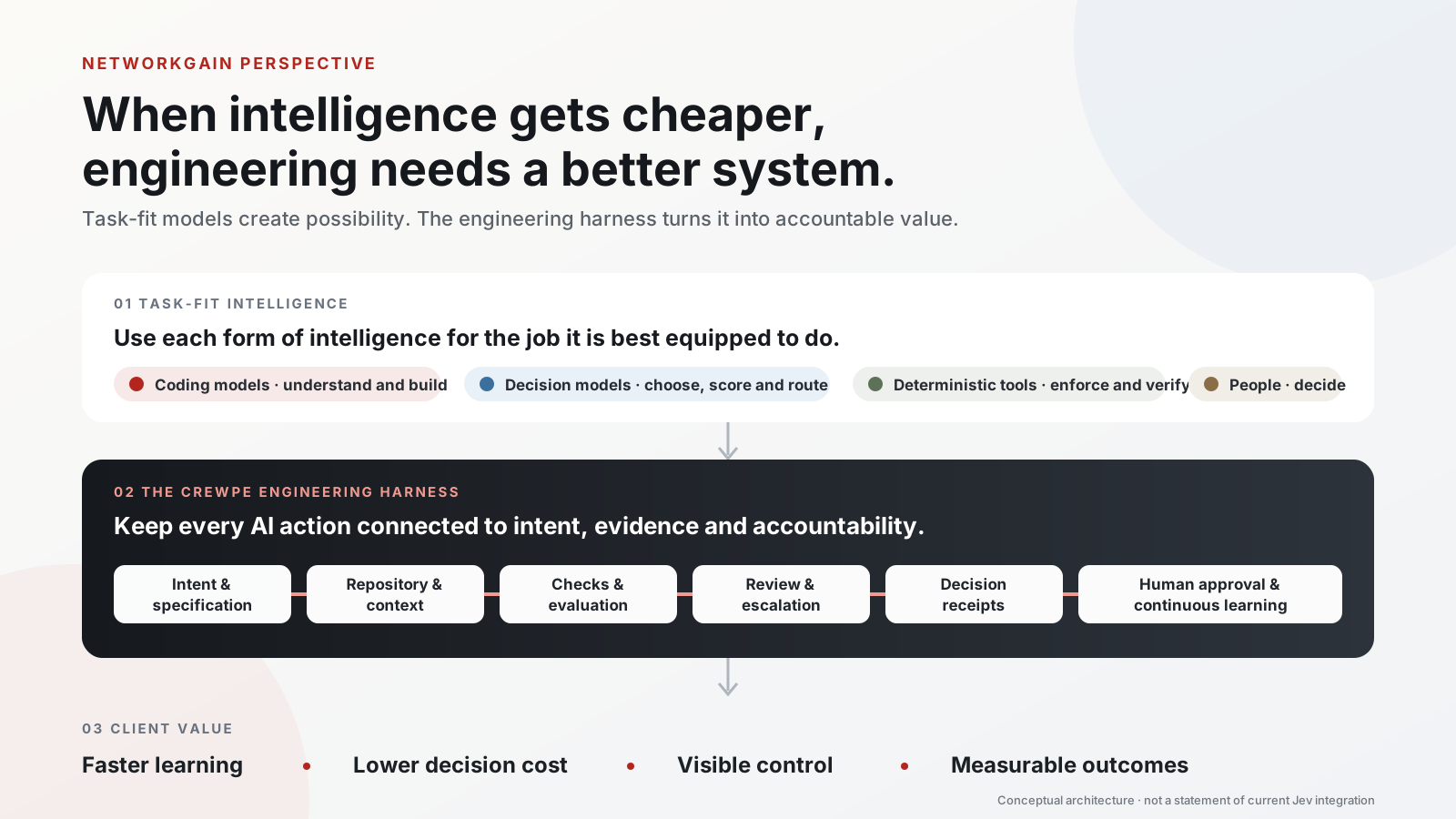
The likely architecture of mature AI engineering is therefore not one model doing everything. It is a portfolio:
- Generative models for interpretation, design, implementation, and explanation
- Decision models for bounded classification, scoring, routing, and escalation
- Deterministic tools for rules, tests, policies, calculations, and reproducible checks
- People for judgment, accountability, exceptions, and release authority
The design question becomes: which form of intelligence is appropriate for each task, and what must be true before its output is allowed to influence the next action?
That is a healthier question than asking which model should run the entire lifecycle.
Cheaper intelligence will increase the volume of engineering
Jev’s name refers to the Jevons paradox: when a resource becomes more efficient and affordable, overall use can increase rather than decline. TypeSafe makes that connection explicitly in its launch note.
The same dynamic is already visible in AI engineering. When the cost of generating, classifying, checking, and routing work falls, teams do not simply perform the old amount of work more cheaply. They try more ideas. They run more evaluations. They create more branches. They ask agents to operate more frequently and with greater autonomy.
That can be enormously valuable. Lower-cost intelligence can make continuous evaluation practical. It can help smaller teams build systems that previously needed specialised infrastructure. It can make software responsive to context without requiring a large model call for every small judgment.
It can also increase the amount of change moving through an engineering organisation.
More generated changes create more dependencies to understand. More automated decisions create more paths to inspect. More experiments create more evidence to compare. More autonomous actions create more need for thresholds, escalation, review, and accountability.
The cost of intelligence may fall while the cost of ambiguity rises.
A cheaper model call is not cheaper software delivery
Suppose a team can now generate code faster and route agent decisions for a fraction of its earlier inference cost. The team still has to answer fundamental questions:
- What outcome is the change meant to achieve?
- Which constraints and dependencies in the repository matter?
- What evidence will establish that the change works?
- Which risks require specialist review?
- Who can approve release?
- Can the organisation reconstruct why the system acted?
- Did the resulting change create measurable client or business value?
None of those obligations disappears because a model is faster.
In fact, falling model costs can make them more important. If teams attempt ten times as many changes, weak specifications and late validation become more expensive in aggregate. If an agent can make hundreds of routing decisions, an unclear escalation policy can propagate quickly. If a confidence score is used as a gate, the threshold, calibration, fallback, and consequences need to be understood.
The bottleneck moves from access to intelligence toward the quality of the engineering system that directs it.
This is the point at which a harness matters.
The role for EnWithAI CrewPE
We see CrewPE from EnWithAI as a guided, traceable engineering harness across the lifecycle: connecting intent and specification to development, review, testing, delivery, and learning.
CrewPE’s value is not that it must be the model performing every action. Its value is that it can provide the system in which different models and tools perform appropriate actions without losing the thread of the work.
That thread includes:
- the business intent behind a change;
- the specification and acceptance criteria that bound it;
- the repository context and dependencies that shape it;
- the checks and evaluations that test it;
- the review and escalation decisions that govern it;
- the evidence and approvals that support release; and
- the learning captured for the next cycle.
This is what turns a collection of capable tools into an engineering operating system.
The distinction is especially important for clients. A demonstration can show that an agent completed a task. An enterprise delivery system must show why the task existed, what the agent changed, which checks passed, where uncertainty remained, who made the consequential decisions, and whether the outcome justified the effort.
CrewPE is designed around that larger chain of confidence.
How Jev could fit—without overclaiming
There is no claim here that CrewPE currently integrates Jev. The opportunity is architectural and should be evaluated through testing.
Where the evidence supports it, a specialised decision model could help an engineering workflow:
- select the next action from a bounded set;
- score whether a specification is ready for execution;
- flag a change for deeper security or architecture review;
- route a failed check to the appropriate remediation path;
- identify low-confidence cases for human attention; or
- determine whether a loop should continue, escalate, or stop.
A coding model could then perform the implementation or remediation. Deterministic tools could run tests, policy checks, and repository analysis. People could retain authority over high-consequence choices. CrewPE would keep each action connected to the requirement, the codebase, the evidence, and the accountable team.
The TypeSafe JavaScript SDK illustrates why this is plausible: questions and allowed answers are defined in code, and the response can be handled as typed data. But technical fit is only the beginning.
Before such a model should influence an enterprise workflow, teams would need to establish:
- accuracy and calibration on their own decision set;
- behaviour on ambiguous, adversarial, or incomplete context;
- thresholds for autonomous action versus human review;
- deterministic fallbacks for failure or unavailability;
- observability, replay, and audit requirements;
- privacy, security, latency, and jurisdiction constraints; and
- whether the economic gain survives the full delivery lifecycle.
That is how CrewPE can adopt new intelligence responsibly: not by attaching every new model to the workflow, but by evaluating where it improves a well-defined decision while preserving control of the system.
Where clients can gain value
The combination of specialised intelligence and a lifecycle harness creates four practical sources of value.
1. Lower decision cost
Small, frequent judgments need not consume the same resources as deep implementation work. Matching model capability to task complexity can reduce unnecessary inference cost and latency.
2. Faster learning
Lower-cost decisions make more frequent evaluation possible. Teams can test workflows, thresholds, and routing policies with real evidence instead of relying only on occasional manual reviews.
3. Visible control
Confidence signals become useful only when the surrounding system knows how to respond. CrewPE can connect a low-confidence result to escalation, a failed check to remediation, and an approval to a release record.
4. Measurable outcomes
The client value is not the number of model calls avoided or agent actions completed. It is the time saved to a trusted release, the rework avoided, the risks surfaced earlier, and the business outcome delivered.
These benefits are not automatic. They appear when the architecture, operating model, and measurement system are designed together.
The questions enterprise leaders should ask
The rise of models such as Jev should prompt constructive experimentation—not premature standardisation and not defensive rejection.
Leaders can begin with five questions:
- Which recurring decisions are sufficiently bounded for specialised intelligence? A useful candidate has clear context, a constrained answer space, and a measurable standard of quality.
- What happens when confidence is low? Escalation must be designed before autonomy is granted.
- Which controls should remain deterministic? Security rules, policy constraints, tests, and calculations often need reproducibility rather than probabilistic judgment.
- Can we reconstruct the chain from intent to release? Every important action should remain connected to its specification, evidence, and approval.
- Does the lower unit cost improve an outcome—or merely increase activity? The relevant measure is cost per trusted outcome, not cost per call.
These questions make the enterprise more open to innovation, not less. They create the conditions under which new models can be adopted quickly without making the delivery system opaque.
The NetworkGain view
We should welcome a market in which intelligence becomes more varied, accessible, and affordable.
Developers gain more design freedom when they can choose a model by task rather than force one large model to do everything. Smaller teams gain room to experiment. Enterprises gain the ability to apply machine judgment more frequently and precisely.
But inexpensive intelligence will not remove the need for engineering discipline. It will increase the need for it.
As the number of model-assisted actions grows, advantage will move to organisations that can connect those actions to clear intent, explicit checks, visible decisions, human accountability, and measurable value. This is the opportunity for CrewPE: to act as the harness through which new forms of intelligence can be evaluated, directed, and trusted.
The important question is no longer simply whether AI can do more engineering work.
It is whether we can show that the work is correct, controlled, and valuable.
Model intelligence is becoming easier to access. The next advantage will come from how thoughtfully we put it to work.