We are entering a phase where executives can talk to almost any document.
Upload a report. Ask what changed. Ask why it changed. Ask what management should do next. Within seconds, AI produces an explanation that sounds considered, connected, and complete.
That is useful. It is also where the danger begins.
Imagine an executive asks: Why did South Region revenue fall by 12 percent? The AI points to a softer quarter, a change in product mix, possible inventory constraints, and pressure from discounting. It sounds like an analyst who has spent days with the business.
But the source report contains only an aggregate revenue movement. It does not contain order-level detail, stock availability, discount history, territory vacancies, customer concentration, or lost-account data.
The AI has not seen the business. It has seen the report.
A report is a map. The business is the terrain. AI can become a remarkably articulate guide, but a fluent guide with an incomplete map can get us lost faster.
The system may have made the report easier to question. It did not necessarily make the evidence richer. That distinction is the foundation of trustworthy conversational analytics.
A report can become an interlocutor. It must not become an oracle. The future is conversational access to governed enterprise evidence, with every material claim visibly separated into fact, inference, hypothesis, and unknown.
Interlocution Is a Real Breakthrough
Generative AI changes how a person can engage with a report. The reader no longer has to accept the author’s sequence, emphasis, or level of abstraction. They can ask the document to explain an assumption, expose a contradiction, compare scenarios, translate implications for a role, or propose a test.
M Murali describes this as epistemic interlocution: moving from “What does this report say?” to “What should this report make us think, question, test, and do?”
For an external research paper, technology outlook, or analyst report, that is a meaningful leap. A dense publication can become a structured conversation across the organisation:
- A CXO can ask which strategic assumptions the report weakens.
- A business leader can convert an industry signal into a 90-day learning experiment.
- An operator can identify edge cases that the report’s authors may never encounter.
- A strategy team can invert the argument and ask what evidence would change its conclusion.
The value is not a shorter summary. It is a better field of enquiry: a static information object becomes a generator of questions, hypotheses, and possible action. An internal management report, however, demands a different contract.
Every Report Leaves Something Outside the Frame
Suresh Vijayaraghavan makes the enterprise caveat explicit: management information is not operational reality presented without mediation. It is a constructed view.
Source-system events pass through definitions, filters, transformations, exclusions, aggregation, and presentation choices before they reach the executive. “Revenue,” “active customer,” and “qualified pipeline” may each mean something precise—and different—from what their labels imply.
A report is designed for a purpose. It selects certain measures, compresses events, and presents a manageable view. That is precisely why it is useful. But every act of compression leaves something outside the frame: a customer conversation, an operational constraint, a policy decision, or a human behaviour that may explain the movement.
The report may therefore be correct and still be insufficient for the question being asked.
If an AI receives only the finished report, it cannot recover evidence that the report never contained. It may compare periods, restate trends, and suggest plausible causes. It may also blur the line between what the report proves and what a statistically fluent narrator believes could be true.
Conversation can expand the question space without expanding the evidence space.
That is the hidden risk in “chat with your data” propositions. A static report displays its limits. A conversational response can conceal them inside an elegant explanation.
Trust therefore depends not only on whether the language model is accurate. It depends on whether the enterprise can show which evidence the system was allowed to reach, how that evidence was defined, and which parts of the response extend beyond observation.
External Research and Internal MIS Need Different Contracts
When we interrogate an external report, we usually understand that it is a published perspective. The goal is exploration. We want implications, counterarguments, scenarios, and questions for further investigation.
When an executive interrogates internal MIS, the implied promise is stronger. They expect an answer about their organisation. The system needs to understand the governed definition of the metric, the reporting period, source freshness, transformation lineage, permitted drill-down paths, and the limits of the available evidence.
| Context | Primary purpose | Responsible output |
|---|---|---|
| External research or analyst report | Exploration and strategic learning | Questions, implications, hypotheses, and experiments grounded in the source |
| Internal management information | Executive analysis and decision support | Governed facts, approved calculations, traceable evidence, explicit inference, and visible unknowns |
For internal decision support, the best executive AI should therefore do four things:
- Say what the available information actually shows.
- Say what it does not explain.
- Identify the evidence required to investigate further.
- Suggest the next useful question rather than manufacture a convenient answer.
This is a small shift in behaviour, but a large shift in trust. With external research, use AI to open thought rather than close judgement. With enterprise evidence, require it to show where exploration ends and a decision-grade claim begins.
Four Stages of Conversational Analytics Maturity
The enterprise journey is not one deployment called “ask your data.” It is a progression in what the system can responsibly access, claim, and help the organisation learn.
1. Chat with the report
The AI reads a PDF, spreadsheet, presentation, or dashboard export and answers questions from that material. This improves discovery and interpretation. The source document remains the truth boundary.
This is useful for research, market studies, and low-risk exploration—as long as users can see that the answer is bounded by the supplied material.
2. Reports as governed tools
An agent can discover approved reports, apply authorised parameters, and compare standard views. It can move across reports, but still inherits the reporting estate’s definitions and blind spots.
3. Governed evidence interlocution
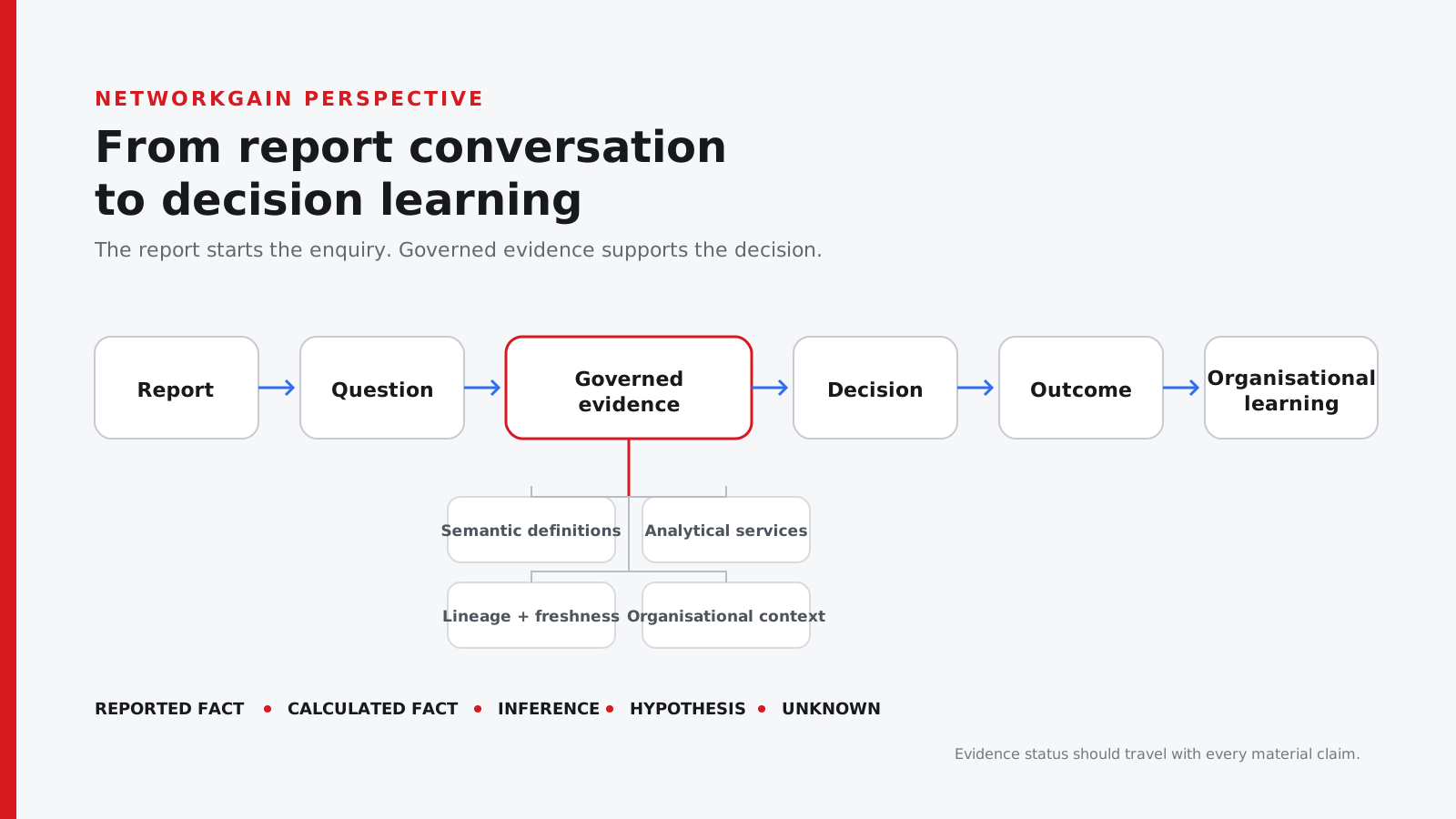
The report becomes a starting point rather than a stopping point. The agent can reach approved metrics, semantic definitions, analytical services, lineage, organisational context, and permitted supporting records.
Model Context Protocol, or MCP, can serve as an access plane through which an agent discovers and invokes those governed capabilities. It is not itself a source of analytical truth. Trust comes from the definitions, permissions, data products, calculation services, freshness controls, and auditability behind that access plane.
The agent should receive bounded, role-aware capabilities—not unrestricted access to operational databases.
4. Decision learning
The organisation preserves the chain from question to evidence, decision, expected result, observed result, and revised understanding. It can later ask not only “What did we decide?” but “Which evidence influenced us, what did we expect, what happened, and what should change in our model of the business?”
At this stage, conversational analytics becomes part of institutional learning. The report is no longer the final artefact. It is one signal inside a governed decision loop.
Architecture Must Expand Evidence Without Dissolving Control
A decision-grade design has several distinct layers.
The conversational interface receives the executive’s question. An agent or orchestrator decomposes the enquiry and decides which approved capabilities are relevant. A governed access plane exposes only what that identity and use case are permitted to invoke. Behind it sit the semantic layer, analytical services, lineage, organisational knowledge, and approved data products.
Each layer has a different responsibility:
- Semantic definitions preserve the meaning of metrics, dimensions, and business terms.
- Analytical services perform approved calculations rather than asking the model to improvise arithmetic or causal analysis.
- Lineage and freshness show where evidence came from, how it changed, and whether it is current enough for the decision.
- Organisational context brings policies, operating events, decision rights, and relevant knowledge into the permitted evidence set.
- Identity and authorisation ensure that conversational convenience does not bypass existing boundaries.
- Audit records reconstruct the evidence, tool calls, transformations, and claim status behind the response.
Five Labels That Keep the Answer Honest
Architecture alone will not give an executive the right mental model. Every material claim should reveal its evidence status.
- Reported fact — returned directly by a governed report or approved source.
- Calculated fact — derived by an approved analytical service using governed definitions.
- Inference — an interpretation supported by evidence but not directly observed.
- Hypothesis — a plausible explanation that still requires validation.
- Unknown — the available evidence is insufficient for a responsible answer.
A single response may contain all five: a reported decline, a calculated customer contribution, an inference about order timing, a hypothesis about stock constraints, and an honest statement of what remains unknown.
These labels do not weaken executive communication. They make it decision-worthy. Leaders can act differently on a verified result, a derived pattern, and a proposition that still needs a test.
They also create a practical discipline for the system: never allow confidence of expression to substitute for status of evidence.
The Five-Question Executive Diagnostic
The next time an AI explains a report, do not begin by asking whether the answer sounds intelligent. Ask:
If this answer is wrong, can I see exactly where the evidence ended and the story began?
If the system cannot show that boundary, it may still be useful for exploration. It is not yet ready to carry executive confidence. Before allowing GenAI to explain enterprise performance, leadership teams should ask:
- Does the system know the governed definition of every metric it discusses? A label is not a definition, and a definition without ownership or version history is not governed.
- Can it move from the reported result to permitted supporting evidence? A drill-down path should be intentional, role-aware, and relevant to the decision—not unrestricted database access.
- Does it reveal source period, refresh time, lineage, and definition changes? An accurate answer from stale or redefined data can still produce a poor decision.
- Does it distinguish fact, calculation, inference, hypothesis, and unknown at claim level? A disclaimer at the bottom of a confident narrative is not enough.
- Can the organisation reconstruct how evidence led to a decision and whether the expected result occurred? Without that chain, the organisation can automate explanation without improving judgement.
If the answer to these questions is unclear, the issue is not that the organisation needs a better prompt. It needs a stronger evidence and decision architecture.
Start With One Decision, Not an Enterprise-Wide Chatbot
The first useful implementation can be narrow.
Choose one recurring executive decision where the current report is important but insufficient. Identify one governed metric at its centre. Define one permitted drill-down path. Establish the claim-status rules. Record the decision, expected result, and later outcome.
For example, a revenue review might begin with a reported regional variance, then invoke approved contribution analysis. It should expose the metric definition and freshness, label possible explanations, and identify the next evidence required. After leaders act, it should compare the expected and observed result.
That loop tests whether definitions, permissions, analytical services, missing context, and decision learning work together.
It also keeps the technology in proportion. The goal is not an AI that always has an answer. The goal is an enterprise that knows what it knows, knows what it is inferring, and knows what it must learn next.
Experience Report Interlocution—Then Design the Evidence Path
The CLEAR™ Engineering Intelligence Foundry V1.2 lets leaders experience the report-to-question part of this journey. It can turn a complex public report or white paper into role-specific questions, competing hypotheses, executive implications, and possible action paths.
Try CLEAR™ Engineering Intelligence Foundry V1.2 with a public or non-confidential report.
The current GPT is an experiential interface. It is not a substitute for a governed enterprise analytical architecture, and confidential enterprise information should not be uploaded to it.
Use it to open thought, not outsource judgement.
NetworkGain can help a leadership team take the next step: bring one executive question and the report currently used to answer it. We will map the gap between report conversation and governed evidence—across meaning, evidence access, analytical services, claim status, decision rights, and the learning loop.
The ambition should not be to make every report sound intelligent. The real measure of intelligence is not how confidently a system answers. It is whether the system knows where its answer ends.
It should be to make governed organisational evidence conversational—without weakening meaning, security, traceability, or accountability.
The report can start the conversation. It should not define the boundary of what the enterprise can know.
This Perspective is attributed to Suresh Vijayaraghavan and M Murali. Murali developed the framing of epistemic interlocution and the prompt-playbook approach. Suresh sharpened the enterprise MIS caveat and the governed analytical MCP architecture. NetworkGain has synthesised these contributions into the maturity path, executive diagnostic, and decision-learning model presented here.