Microsoft Outlook is a useful symbol of how software grew up.
Over decades it accumulated an extraordinary range of capabilities: rules, folders, categories, calendars, contacts, tasks, searches, settings, views, add-ins and administrative controls. Yet many people spend most of their day using only a few actions: write, reply, accept, decline and find.
This is not a criticism of Outlook. It is a description of the software era we built.
Every new capability needed somewhere to live. So applications expanded through menus, toolbars, forms and workflows. The user became the translation layer—turning a business intention into the sequence of clicks the software required.
Agentic AI reverses that relationship.
Instead of asking a person to learn the application’s structure, the system can interpret the person’s intent, assemble the relevant context, choose the appropriate tools and carry out the work. A user should be able to say, “Find the customer commitments I made this week, schedule the follow-ups and draft the responses,” without knowing which menu, database or application owns each step.
That is why the future of software is not simply fewer screens. It is a different allocation of work between people and machines.
Our view is straightforward:
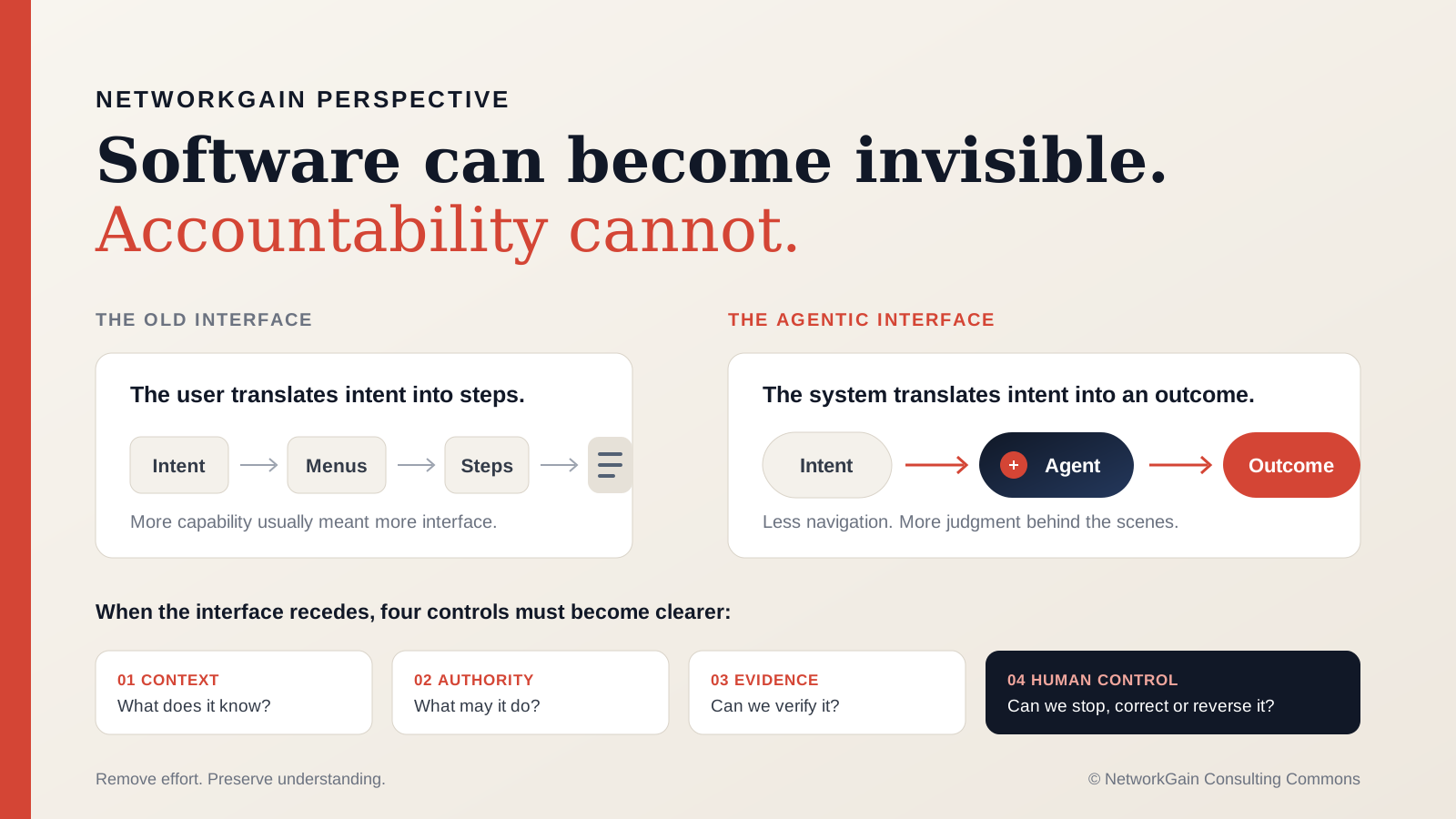
Software can become invisible. Accountability cannot.
The interface does not disappear. It moves—from menus and buttons into context, judgment, authority and evidence. Companies that understand this distinction will create simpler experiences without creating opaque operations.
The interface was doing translation work
Traditional enterprise software asks people to think like the application.
To complete an outcome, the user must know where the relevant information sits, which fields are required, what sequence the workflow expects and which application should be opened next. Training, process manuals and support teams exist partly because every system has its own grammar.
The feature-rich interface is therefore more than a presentation layer. It is a map of the software’s internal logic.
That map can be valuable. It helps people discover capability, compare information and understand what will happen before they act. But it also transfers effort to the user. Each additional feature creates another choice. Each specialised application adds another vocabulary. Each handoff between systems creates another point at which context can be lost.
For routine work, people rarely want more controls. They want less translation.
They do not want to “use the CRM.” They want the customer record to be accurate. They do not want to “navigate the service portal.” They want the issue resolved. They do not want to “run the procurement workflow.” They want the right purchase approved under the right policy.
The outcome was always the point. The interface was the price of getting there.
Agents reverse the relationship
An agentic system starts with intent rather than navigation.
It can interpret a request, retrieve relevant information, reason about the next step, call tools across applications and return a result. Microsoft’s guidance for autonomous agents describes systems that perceive events, make decisions and execute tasks using triggers, instructions and guardrails. OpenAI’s agent tooling similarly treats context, tools, orchestration, tracing and human review as parts of the working system—not as features on a screen.
The change can be expressed simply:
Traditional interface: intent → menus → steps → application
Agentic interface: intent → context → judgment → action → outcome
This matters because the user’s job changes. They move from operating each piece of software to setting direction, supplying judgment and managing exceptions.
The application also changes. Its features do not necessarily vanish. They become capabilities that an agent can call through an API, tool or workflow. The calendar still stores the meeting. The CRM still holds the customer record. The finance system still posts the transaction. But the user may no longer need to visit each interface to complete the larger job.
The visible application becomes smaller. The operating system behind the experience becomes more capable.
Invisible does not mean interface-free
The most important mistake would be to interpret this shift as the end of visual software.
A conversation is efficient when the user knows what they want. A visual interface is often better when they need to explore, compare or discover. A simple agent can schedule a familiar meeting. A calendar view is still useful when a person needs to understand the shape of a month. An agent can recommend an investment allocation. A visual model is still necessary when a committee must examine trade-offs.
High-stakes work also needs moments of deliberate friction. A payment, contract, production deployment, employee decision or regulatory submission should not disappear behind a smooth sentence merely because the technology can execute it.
The better design principle is:
Remove effort, not understanding.
Routine, reversible and well-bounded work can become nearly invisible. Ambiguous, consequential or irreversible work should reveal more: the evidence used, the decision made, the authority exercised and the person accountable.
The strongest agentic products will therefore use progressive visibility. They will stay quiet when confidence is high and risk is low. They will show options when judgment is needed. They will pause for approval when consequences rise. And they will always make it possible to inspect what happened.
Four things must become more visible
When buttons disappear, controls cannot disappear with them. Four questions become the real interface.
1. Context: what does the agent know?
An agent’s answer is only as reliable as the context it can access and correctly interpret. Enterprises need to know which records, conversations, policies and histories informed an action; whether that information was current; and where it came from.
Context without provenance is confidence without a foundation.
2. Authority: what may the agent do?
Access to information is not permission to act. The enterprise must distinguish between reading, recommending, drafting, approving and executing. Authority should be scoped by role, task, value, risk and time—not granted as a broad convenience.
The question is no longer only “Can the system do this?” It is “Under whose authority, within which boundary, may it do this now?”
3. Evidence: can the outcome be verified?
An agentic action should leave a usable trail: the request, relevant context, decision path, tool calls, changes made, checks performed and exceptions raised. OpenAI’s current agent guidance makes tracing, guardrails and review explicit concerns. NIST’s AI Risk Management Framework likewise treats accountability structures, documented roles and systematic documentation as foundations of trustworthy operation.
If the work cannot be inspected, it cannot be governed at enterprise scale.
4. Human control: can a person stop, correct or reverse it?
Human oversight is not a person clicking “approve” on everything. That recreates the old interface with extra steps. Good oversight places people at the points where judgment changes the outcome: policy exceptions, low-confidence decisions, material commitments and irreversible actions.
People need the power to intervene—and enough information to intervene intelligently.
The SaaS value stack is moving
For two decades, enterprise software differentiation was often expressed through feature breadth. More modules, more workflows and more configuration helped justify a higher tier and made the application harder to replace.
The agentic layer changes that equation.
If an agent can call the necessary capability across several systems, the user may care less about which product owns the button. A feature that once attracted users into an application can become a tool available beneath the agent. Products that compete mainly through interface density risk becoming interchangeable execution layers.
But this does not mean enterprise applications cease to matter.
Systems of record remain essential. APIs, identity, permissions, data quality, transaction integrity, security and resilience become more important as agents act across organisational boundaries. An application with trusted data and well-defined actions may gain value even if fewer people visit its home screen.
The risk is not “SaaS disappears.” The risk is that some SaaS companies mistake interface ownership for customer ownership.
The durable value moves toward five assets:
- trusted enterprise context;
- reliable capabilities exposed as tools;
- judgment about how and when to use them;
- authority to act within clear boundaries; and
- evidence that the outcome was correct.
Incumbents that possess deep workflow knowledge, trusted data and mature permission models can thrive in this shift. New entrants can win by coordinating work across old boundaries. Both must decide where they create distinctive intelligence and where they provide dependable infrastructure for someone else’s agent.
From feature economy to outcome economy
The old buying question was: Does this software have the feature we need?
The new operating question is: Does this agent have the context, judgment and authority to achieve the outcome—and can we trust the result?
That changes the unit of value.
Feature adoption, active seats and time spent inside an application become incomplete measures. A product may create more value by removing a screen than by increasing engagement with it. The more useful measures are closer to completed work: elapsed time, human effort removed, exception rate, error rate, reversibility, policy compliance and cost per trusted outcome.
This is a profound change for product design and for investment.
Software companies have historically been rewarded for becoming the place where work happens. Agentic companies may be rewarded for making work happen across many places while asking for very little attention.
The winning experience may feel almost empty. Its sophistication will sit behind the surface—in the quality of its context, decisions and controls.
What enterprise leaders should do now
This is not a reason to replace every interface with a chat box. It is a reason to redesign work from the outcome backwards.
Map jobs, not screens
Identify the frequent outcomes for which people cross multiple applications, re-enter information or follow predictable steps. Those journeys are stronger candidates for agentic redesign than an arbitrary list of software features.
Classify authority before granting autonomy
For each action, decide what the agent may read, recommend, draft, execute or never do. Set explicit thresholds for approval, escalation and reversal. Authority is an operating-model decision before it is a technical permission.
Design the exception experience first
The routine path will become increasingly easy. Advantage will come from how well the system handles uncertainty: missing context, conflicting policies, failed actions and decisions that require human judgment.
Make provenance part of the product
Users should be able to see why an important recommendation was made, what source was used and what action followed. Evidence should be generated as the work happens, not reconstructed after an incident.
Measure trusted outcomes
Track the result and the cost of producing it, including human review, corrections and rework. A fast autonomous action that creates hidden clean-up is not an efficiency gain.
Keep visual interfaces where they improve thought
Use agents to remove navigation and repetition. Preserve visualisation where people need pattern recognition, comparison, simulation or shared deliberation. The goal is not fewer pixels. It is less avoidable effort.
How NetworkGain, EnWithAI and the cohort ecosystem can help
Moving from feature-rich software to outcome-rich intelligence crosses strategy, architecture, engineering, security and governance. It cannot be solved by placing a conversational layer over the existing estate.
NetworkGain helps leadership choose the right outcomes, redesign decision rights and establish the operating model for accountable agency. The work begins with the business result: what should become effortless, what must remain visible and where human judgment creates value.
EnWithAI can translate that model into an executable agentic architecture: context pathways, tool integrations, permission boundaries, evaluation, observability and controlled human handoffs. Its CrewPE engineering approach is relevant because invisible software must still be specified, tested, reviewed and traced through delivery.
The wider cohort ecosystem brings the complementary expertise the change requires—cybersecurity, cloud, data, domain, legal, design and organisational adoption. Together, the cohort can address the full path from intent to evidence rather than optimising one interface in isolation.
A practical starting point is one meaningful, cross-system outcome. Map the current effort. Define the agent’s authority. Build the context and controls. Test routine work and exceptions. Measure the trusted result. Then expand from evidence rather than enthusiasm.
The NetworkGain view
The next generation of software will not win because it offers the longest feature list. It will win because it understands what the user is trying to achieve and can complete more of the work with less friction.
But simplicity at the surface cannot be purchased with opacity underneath.
As software becomes less visible, the enterprise must make context, authority, evidence and human control more visible. That is the design contract for agentic AI.
The future is not feature-rich software.
It is outcome-rich intelligence—with visible accountability.