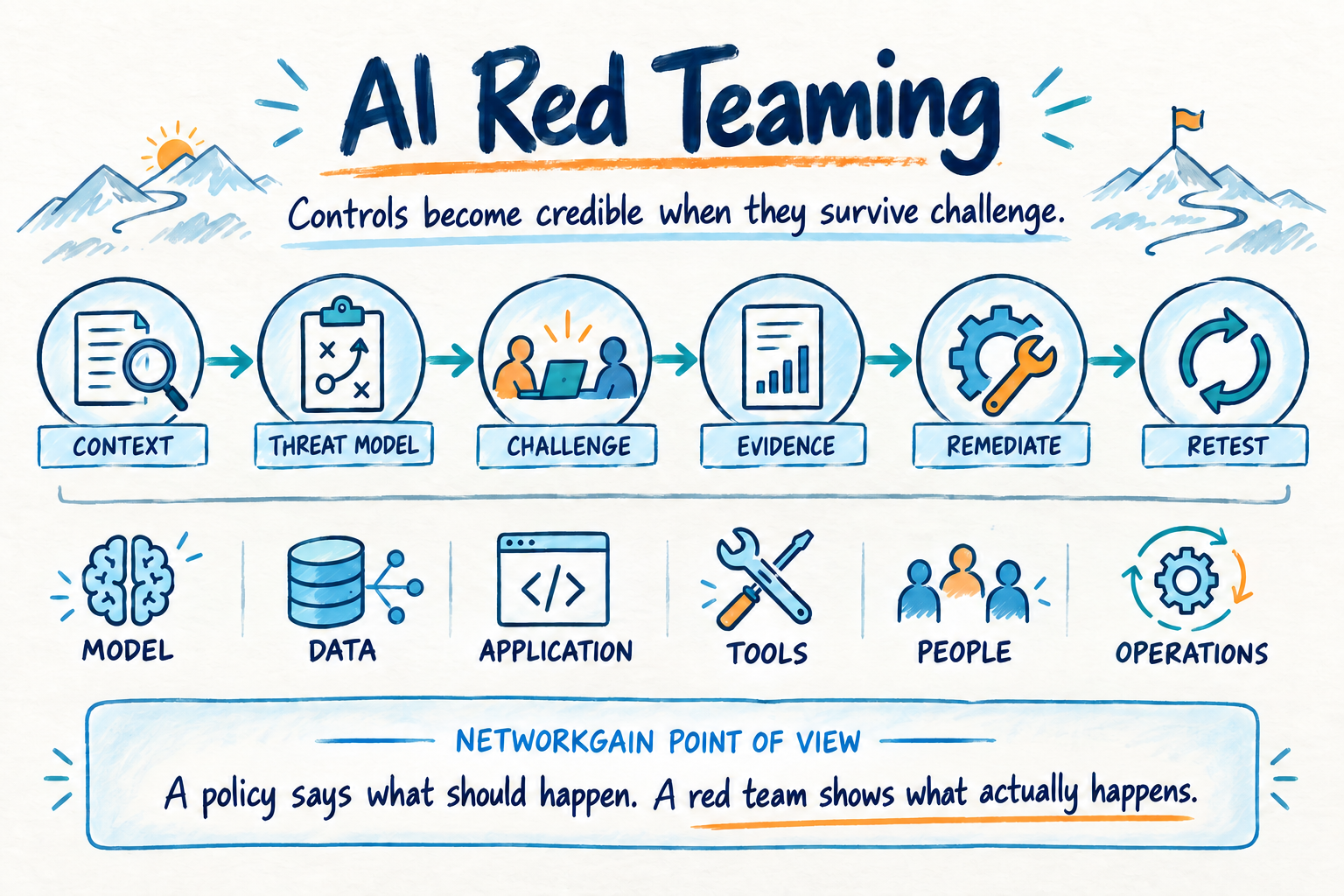
Most enterprise AI controls begin as statements of intent.
The model should not reveal sensitive data. The assistant should refuse harmful requests. The agent should use only approved tools. Human approval should prevent a high-impact action. Monitoring should detect misuse. The vendor’s safeguards should hold.
Each statement may be reasonable. None becomes assurance until someone tries to make it fail.
That is why enterprise AI needs a red team.
An AI red team applies informed, authorised adversarial challenge to an AI system so the organisation can see how it behaves under pressure. It tests the model, but it does not stop at the model. It follows the path through data, prompts, retrieval, applications, identities, tools, APIs, workflows, people, monitoring, and incident response.
The central idea is simple:
A policy says what should happen. A red team shows what actually happens.
This is the practical value of red teaming. It converts assumptions into evidence before customers, employees, attackers, auditors, or regulators discover the gap in production.
The Real Risk Sits In The Complete AI System
Traditional security testing remains necessary. Networks, endpoints, applications, APIs, identity systems, cloud configurations, and software dependencies still need established security controls.
AI adds a different class of uncertainty.
The same model can behave differently when instructions change, context grows, retrieval returns poisoned material, a user changes language, a tool produces an unexpected result, or several individually acceptable steps combine into a harmful sequence. A model can follow a malicious instruction embedded inside a document. An agent can turn an incorrect answer into an operational action. A safeguard can reduce one risk while making the system unusable for legitimate work.
NIST’s adversarial machine learning taxonomy reflects this broader attack surface. It covers attacks across development, training, and deployment, and distinguishes evasion, poisoning, privacy, and misuse risks. The OWASP Top 10 for LLM and Generative AI Applications brings application risks into view, including prompt injection, sensitive information disclosure, supply-chain weaknesses, data and model poisoning, improper output handling, excessive agency, and unbounded consumption.
The important point for leaders is not the length of the threat list.
It is that AI risk crosses organisational boundaries.
A security team may understand attack techniques but lack the business context required to judge harm. A data team may understand provenance but not identity misuse. A model team may test output quality but not the downstream action that follows. A compliance team may define a control but not know whether it survives a manipulated workflow.
AI red teaming brings these perspectives together around a real system and a defined consequence.
Reader takeaway: The target is not only the model. The target is the complete decision and action path around the model.
AI Red Teaming Is Different From A Penetration Test
AI red teaming grew from established cyber red-team practice, but a simple relabelling of penetration testing is insufficient.
A conventional penetration test usually asks whether a known technical weakness can be exploited. AI red teaming must also ask whether the system can be induced to behave in an unsafe, misleading, biased, privacy-invasive, or operationally harmful way. Some failures arise from software vulnerabilities. Others arise from the interaction between model behaviour, system design, operating context, and human judgement.
The exercise may test whether an attacker can:
- override system instructions through direct or indirect prompt injection;
- extract confidential information from connected data or conversation history;
- manipulate retrieval sources, training data, or model artefacts;
- exploit an agent’s tools, permissions, or delegated authority;
- create harmful outputs that pass through weak validation;
- trigger excessive consumption, looping, or denial of service;
- exploit human trust in fluent but incorrect output;
- or move from an AI-specific weakness into a conventional enterprise attack path.
This requires a multidisciplinary team. Security expertise is essential, but so are AI engineering, data, privacy, legal and compliance judgement, domain knowledge, safety thinking, product understanding, and operational ownership.
NIST’s Generative AI Profile makes the same point: the quality of red-team results depends on the team’s expertise and its understanding of the deployment context. Microsoft reached a similar conclusion after red teaming more than 100 generative AI products. Its published lessons stress that AI red teaming is not the same as safety benchmarking, that human expertise remains critical, and that securing AI systems never becomes a finished task.
Reader takeaway: AI red teaming combines technical attack skill with business, domain, safety, and governance judgement.
Why A Red Team Is Now An Operating Requirement
1. AI Behaviour Cannot Be Fully Specified In Advance
Conventional software is difficult to secure, but teams can usually reason from explicit code paths and deterministic rules. Generative AI behaves probabilistically. Its output depends on the model, prompt, context, retrieval, system configuration, tool access, and conversation state.
Predefined evaluations can test expected cases. A red team searches for the unexpected interactions that ordinary test suites miss.
2. Agentic AI Converts Output Risk Into Action Risk
An incorrect answer may inconvenience a user. An agent with access to email, code, customer records, enterprise systems, or payment workflows can turn an incorrect answer into a consequential action.
OWASP describes excessive agency as a combination of excessive functionality, permissions, or autonomy. Red teaming tests whether approval gates, identity boundaries, transaction limits, tool restrictions, and stop controls still work when instructions conflict or context is manipulated.
3. Vendor Assurance Does Not Cover The Enterprise Configuration
A model provider can test the base model. It cannot fully test the organisation’s prompts, retrieval corpus, data permissions, custom tools, workflow logic, user population, operating procedures, or risk appetite.
Enterprise assurance cannot be inherited entirely from a model card, certification, benchmark, or contract. The implemented system needs testing in its own context.
4. Governance Needs Evidence
Policies, risk registers, approval forums, and control frameworks are useful. They remain theoretical if the organisation cannot demonstrate that safeguards detect, contain, and support recovery from realistic failure.
Red-team findings create evidence for design decisions, risk acceptance, remediation priorities, release gates, and leadership oversight. For some providers of general-purpose AI models with systemic risk, the EU AI Act now makes model evaluation and documented adversarial testing part of the regulatory expectation. The European Commission’s guidance also connects evaluation with systemic-risk mitigation, incident reporting, and cybersecurity safeguards.
For most enterprises, the more immediate reason is operational: leadership needs to know whether a control works before relying on it.
5. Failures Should Improve The System
A useful red-team finding does more than describe a clever attack. It identifies the failed assumption, affected business outcome, attack path, control weakness, evidence, owner, remediation, and retest condition.
That turns an exercise into institutional learning.
MITRE ATLAS provides a living knowledge base of adversary tactics and techniques for predictive, generative, and agentic AI. The OWASP GenAI Red Teaming Guide offers a structured, risk-based method spanning model weaknesses and system integration. These resources are most valuable when an organisation uses them to improve its own scenario library, controls, and engineering standards after every exercise.
Reader takeaway: Red teaming is not a hunt for dramatic failures. It is a repeatable way to make controls more credible and the operating system more resilient.
A Practical Enterprise Red-Team Model
The strongest programmes move through a continuous loop.
Context
Begin with the business use case. Define who uses the system, what decisions or actions it can influence, which data it can access, where it operates, what harm matters, and who owns the outcome.
Risk should determine the depth of testing. A public summarisation assistant and an autonomous agent with production access do not need the same exercise.
Threat Model
Map the complete system. Include the model, system prompts, retrieval sources, memory, application code, APIs, tools, identities, permissions, external services, human approvals, logging, and response process.
Then connect credible actors and techniques to consequences. A useful threat model does not merely say “prompt injection.” It explains who can place the instruction, where it enters, what authority the system has, which control should stop it, and what business impact follows if the control fails.
Challenge
Design scenarios around the threat model and the organisation’s risk appetite. Combine manual exploration with automated coverage. Automation can repeat known attacks at scale. Skilled human testers can adapt when the system behaves unexpectedly, exploit cross-system context, and recognise subtle harm.
Testing should take place under explicit authorisation, data-handling rules, safety boundaries, and escalation procedures. The goal is controlled learning, not uncontrolled disruption.
Evidence
Capture enough information to reproduce and understand the finding: the scenario, inputs, system state, model and configuration, tool calls, outputs, control response, downstream impact, and relevant logs.
Severity should reflect consequence, exploitability, reach, detectability, and reversibility. A surprising response with no meaningful impact should not outrank a quiet failure that exposes data or permits an unauthorised action.
Remediate
Assign a named owner and address the failed control at the right layer. The answer may involve prompt or model changes, but it may also require narrower permissions, stronger output validation, safer retrieval, better data separation, independent approval, rate limits, improved monitoring, or a redesigned workflow.
Retest
Confirm that the fix blocks the original path without breaking legitimate use. Add the scenario to a regression suite. Retest when the model, prompts, data sources, tools, permissions, or business process changes.
The loop matters because AI systems change even when the product name does not. Models are updated, retrieval corpora evolve, tools are added, users discover new interaction patterns, and attackers adapt.
Reader takeaway: A red-team report has limited value without remediation ownership, retesting, and regression coverage.
What Weak Red-Team Programmes Get Wrong
The first mistake is starting with a tool.
Tools such as PyRIT, scanners, attack libraries, and model-based test generation can increase coverage. They cannot decide which business harm matters, whether a finding is material, or what residual risk leadership should accept.
The second mistake is treating red teaming as a one-time launch gate.
A pre-release exercise provides a snapshot. It does not cover later model changes, new retrieval content, expanded permissions, user behaviour, or operating drift.
The third mistake is testing only known prompts.
A fixed jailbreak list may measure consistency against familiar attacks. It does not replace adaptive exploration of the configured system and its real workflows.
The fourth mistake is measuring activity instead of risk reduction.
Prompt counts, attack counts, and tool coverage can look impressive without showing whether material paths were closed. Better measures include critical scenario coverage, reproducible exploit rate, time to detect, containment effectiveness, remediation closure, retest pass rate, regression recurrence, and impact on legitimate user success.
The fifth mistake is leaving findings inside the security team.
An issue without a business owner, engineering owner, decision deadline, and retest condition becomes another document rather than a stronger control.
How NetworkGain Can Help
NetworkGain can help organisations build AI red teaming as an operating capability rather than an isolated technical event.
Establish The Business And Risk Frame
We begin with the AI use cases that matter. We map business purpose, decision impact, data sensitivity, user groups, autonomy, downstream authority, regulatory context, and tolerance for failure. This helps leaders prioritise where red teaming will create the most value.
Build The System-Level Threat Model
We connect business consequences to credible attack paths across the model, data, application, tools, people, and operations. Relevant references can include NIST AI RMF, NIST’s adversarial machine learning taxonomy, MITRE ATLAS, OWASP guidance, and established cyber practices. These frameworks support the work. They do not replace contextual judgement.
Design The Red-Team Operating Model
NetworkGain can define the mandate, roles, authorisation, exercise cadence, evidence standard, severity model, escalation path, and decision rights. We can help determine whether the organisation needs an internal team, an independent external assessment, or a hybrid model.
Coordinate Specialist Execution
Where deep technical testing is required, NetworkGain can govern specialist participation through the appropriate security, AI engineering, data, legal, privacy, and domain expertise. NetworkGain keeps the exercise connected to the business mandate, the complete system, and accountable remediation.
Convert Findings Into A Remediation Roadmap
We help translate findings into risk-ranked actions across architecture, identity, data, workflow, monitoring, governance, and human oversight. Each material action should have an owner, target state, evidence requirement, and retest condition.
Create The Continuous Assurance Loop
NetworkGain can help establish dashboards and review cadences that track control effectiveness over time. The objective is not to promise a risk-free AI system. It is to make exposure visible, decisions accountable, safeguards testable, and improvement continuous.
This distinction matters. NetworkGain can align the programme with recognised frameworks and support readiness, control design, and evidence-based execution. Any formal certification, attestation, legal conclusion, or independent audit requires its own defined scope and qualified authority.
The NetworkGain View
Enterprise AI will not become trustworthy because a policy uses the right language or a platform includes a safety setting.
Trust grows when the organisation can explain what the system may do, challenge it under realistic conditions, see the evidence, correct the weakness, and prove that the correction holds.
That makes red teaming more than a security technique.
It is a management discipline for AI systems that learn, adapt, integrate, and act inside real enterprises.
The organisation does not need to attack everything with equal intensity. It needs to identify where AI can create meaningful harm or exercise meaningful authority, test those paths deliberately, and keep the findings connected to engineering and business ownership.
The goal is not a system that has never failed a test.
The goal is an organisation that discovers important failures early, responds with evidence, and becomes harder to surprise.
That is why enterprise AI needs a red team.
Research Note
This perspective uses the user-provided Get Started With AI Red-Teaming storyboard from Info-Tech Research Group as source context and extends it with current primary guidance from NIST, MITRE ATLAS, OWASP, Microsoft Research, and the European Commission. External frameworks are used as operating references. Applicability depends on the organisation, use case, geography, and engagement scope.