Software organizations have treated source control as plumbing for so long that its strategic role has become easy to miss.
That assumption does not survive agentic engineering.
When a single engineer can supervise several coding agents, the constraint is no longer simply the number of people who can create a branch or write a change. The constraint is the organization’s ability to decide what those changes mean, what evidence supports them, which exceptions are acceptable, and who owns the release decision.
OpenAI’s November 4 announcement that it intends to acquire Pierre Computer Company is consequential less because of the transaction itself than because of what it signals. OpenAI says it wants to evolve the systems around Git for work performed in parallel by developers and coding agents. Two days earlier, its engineering team described Pando, a Git backend built to handle concurrent branches, pushes, fetches and clones at agentic scale. These are vendor claims and a vendor architecture, not an industry standard. But together they identify a genuine operating problem: when change becomes abundant, the control surface around change becomes more valuable.
The executive question is not whether an enterprise needs OpenAI’s stack. It does not. The question is whether its source-control and delivery systems can still connect intent, change, evidence, approval and outcome as the number of changes rises.
The verified signal: Git is being redesigned for parallel work
Verified fact: OpenAI reports that Pando now powers development in its monorepo, supports horizontally scalable writes, and has cut its median push latency by nearly five times. It describes the driver plainly: Codex let engineers do more work in parallel, creating more branches, pushes, merges, fetches and CI activity. It also says its agents and engineers retain Git-compatible workflows.
Verified fact: In the acquisition announcement, OpenAI says Pierre’s Trees and Diffs libraries already support file navigation and change review in Codex. It says it intends to build on existing Git workflows, retain Pierre’s open-source projects, and bring Code Storage capabilities into Codex after the transaction closes. The transaction remains subject to closing conditions.
Neither disclosure proves that every enterprise will encounter OpenAI’s scale problem. A monorepo delivering close to a petabyte of Git data per day is not a universal reference architecture. Nor should leaders translate one company’s implementation choices into a procurement mandate.
The relevance lies elsewhere. A frontier engineering organization has made source-control throughput, review navigation and history-aware tooling part of its response to agentic work. That is a useful signal about where software-delivery friction is moving.
The real issue is decision throughput, not branch throughput
The initial instinct will be to see this as a performance story: agents create too many branches, so Git needs to be faster. Performance matters. Slow clones, unreliable fetches and blocked pushes can turn model capability into waiting time.
But faster writes alone do not make a delivery organization safer or more productive. They can make an already weak decision system fail more quickly.
An agent can open a pull request with code, tests and a polished explanation. It may even address reviewer comments. That does not answer the questions an accountable organization must still resolve:
- What business or product decision authorized this change?
- Which requirement, policy and architectural constraint governed the agent’s work?
- What did the agent inspect, assume or leave uncertain?
- Which automated checks are decisive, and which are advisory?
- Who may accept a security, reliability or customer-impact exception?
- Can a later incident be connected to the diff, evidence and approval that produced it?
These questions are not objections to agents. They are the work that lets agents be used seriously.
NetworkGain analysis: In a human-paced engineering organization, some of this context survives through conversation and institutional memory. In an agent-paced organization, that is unreliable. The ratio of generated change to human attention rises. The evidence and ownership model has to become explicit, searchable and attached to the work.
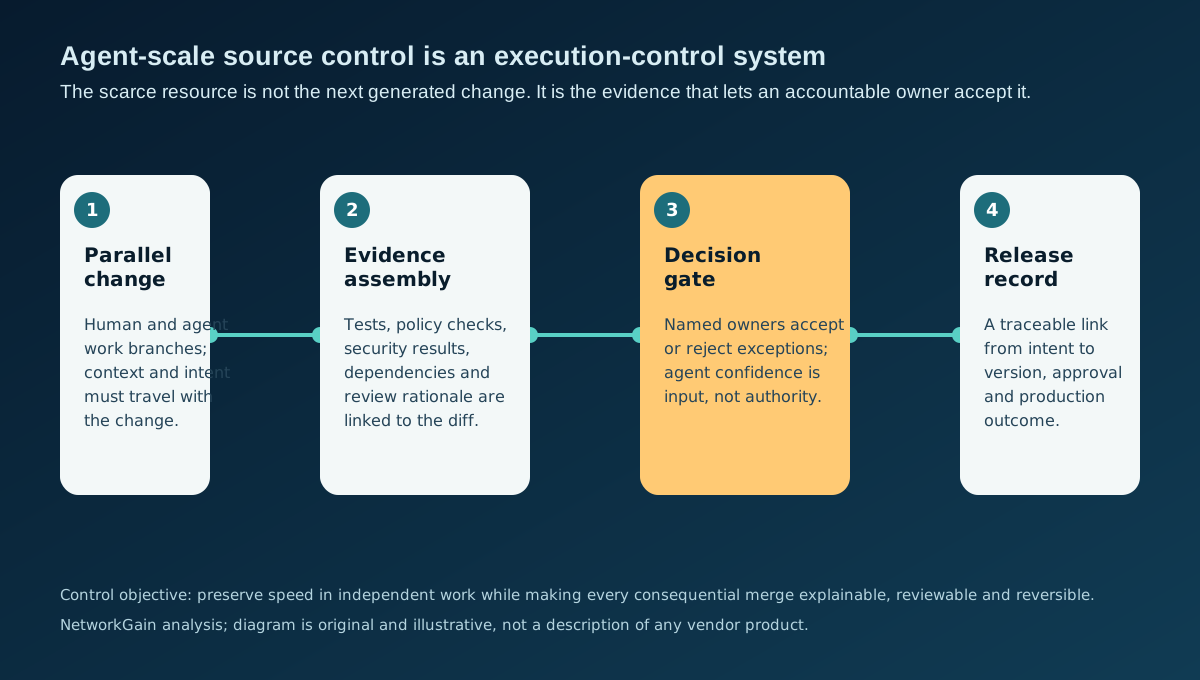
That is why source control is becoming an execution-control system. It is one of the few enterprise surfaces where the proposed change, its history, its reviewers, its tests and the released version can meet. If those connections are fragmented across chat threads, tickets, dashboards and individual memory, delivery speed turns into decision archaeology.
Code review must become evidence review
Conventional pull-request review is mostly a code-reading practice. A reviewer asks whether the implementation is correct, readable and consistent with the system. That discipline remains indispensable. It is not sufficient when an agent can produce a large, internally coherent patch faster than a reviewer can reconstruct its context.
The review unit needs to become larger than the diff and smaller than a full audit.
A useful agent-era review package contains five linked elements:
- Intent: the decision, requirement or hypothesis the change serves.
- Scope: the systems, data, permissions and user journeys affected.
- Evidence: test results, policy checks, security findings, dependency changes and evaluation outputs.
- Exceptions: what failed, was waived or remains unverified, with a named owner and expiry where appropriate.
- Release record: the version deployed, the approval path and the operational signal to watch afterward.
This does not mean demanding a lengthy dossier for every typo. Control should be proportional to risk. A documentation edit, a low-risk internal configuration change and a change to a payments, identity or safety-critical workflow should not travel through the same gate.
The discipline is to make the gate intentional. High-risk change should not inherit low-risk review habits simply because it arrived through the same pull-request interface.
Forward-looking inference: As agents take on more implementation and repair work, the systems that reduce the cost of assembling this evidence will become more important than systems that merely create the next patch. That is an inference from the direction of the announcements, not a forecast about any particular product or acquisition.
The counterargument: Git is a developer concern, not a board concern
There is a reasonable counterargument. Most enterprises do not have OpenAI’s monorepo, its volume of concurrent agents or a need to redesign source-control storage. Leaders should not turn an engineering implementation detail into a board agenda item. The organization may have more urgent priorities: customer value, product direction, cyber resilience, modernization or basic delivery discipline.
That is correct.
The board does not need a Git strategy. It needs confidence that material software change is governed in proportion to its risk, and that management can explain how AI-assisted delivery improves throughput without weakening accountability. The CTO and engineering leaders own the architecture; the board owns the confidence questions.
Likewise, a source-control platform cannot repair vague product strategy, missing ownership or poor testing. It can preserve a trail; it cannot create judgment where none exists.
The implication is not “buy more developer tooling.” It is “use the delivery system you already have to make decision rights and evidence visible before scale forces the issue.” For some organizations that will require new tooling. For others it will begin with clearer pull-request templates, policy-as-code, release criteria, ownership metadata and better integration between the backlog, CI/CD and incident systems.
The operating implication: separate speed from authority
Agentic development makes it tempting to compress execution and approval into one flow. The agent opens the change, generates the tests, summarizes the risk, responds to comments and recommends the merge. That can be useful. It is also a concentration of influence.
An effective operating model separates three things:
- Generation authority: what an agent may draft, change or propose.
- Verification authority: which deterministic controls and independent reviews can establish evidence.
- Acceptance authority: which named human role may accept residual risk and authorize release.
An agent may have substantial generation authority while holding no acceptance authority. That boundary is not anti-automation; it is what makes automation governable.
The practical design choice is to record the boundary in the workflow. A repository rule, an environment gate, a change ticket, an approval policy or a release record can make authority inspectable. A verbal convention cannot do so reliably when the work is moving quickly or an incident occurs months later.
OpenAI’s Pando article is instructive here in a narrow way. Its authors chose to relax repository-wide consistency to let unrelated branches progress independently while maintaining serialization for updates to an individual reference. That is a technical trade-off designed for a particular workload, not a universal governance model. But the pattern is broadly useful: make independence cheap where it is safe; preserve tight controls where contention or consequence demands them.
The NetworkGain view
The decisive asset in AI-native software delivery will not be the agent that writes the most code. It will be the organization that can accept or reject generated change with the least ambiguity.
That requires a source-control and release model that behaves like an execution-control system: it carries intent into implementation, binds evidence to the change, identifies the owner of exceptions, and preserves an auditable release decision. The aim is not bureaucracy around every commit. It is the opposite: remove avoidable human reconstruction work so judgment is applied precisely where risk and value are real.
This complements, rather than replaces, the broader need for specification-led and validated delivery. Specifications make work checkable; source-control evidence makes the resulting change governable. One without the other leaves a gap between what the organization meant to do and what it can later prove it did.
Questions leaders should answer now
Before expanding coding-agent access, CTOs, CIOs and engineering leaders should ask:
- Can we trace a material production change from business intent to deployed version without reconstructing the story by hand?
- Which evidence is mandatory for different change-risk tiers, and who may waive it?
- Are agent-generated tests and risk summaries corroborated by controls the agent does not control?
- Where do developers lose time today: producing change, assembling evidence, or locating a decision owner?
- Which release decisions remain explicitly human, even as implementation becomes more autonomous?
If the answers are unclear, the immediate task is not a sweeping agent platform rollout. It is to design the control path around the work already moving through the organization.
At agentic scale, source control is no longer where code waits. It is where accountable execution becomes visible.