At 6:40 in the evening, a senior manager receives an alert.
An AI system has identified a supplier transaction as suspicious. The recommendation is clear: freeze the payment, suspend the vendor and escalate the account. The confidence score is high. The dashboard is polished. The supporting summary is persuasive.
The manager has ten minutes before the payment window closes.
If she accepts the recommendation, a legitimate supplier may be harmed and an operational dependency disrupted. If she rejects it, the organisation may release a fraudulent payment. The model cannot carry either consequence. The manager can.
What would she need to stand behind the decision?
Not another confidence score. Not a longer explanation generated by the same model. Not a box showing that a human clicked “approve.”
She needs to know what evidence was used, what was missing, which policy applies, how the system has behaved in comparable cases, what alternatives exist, what authority she holds and what will happen if the decision proves wrong. She needs enough time and competence to challenge the recommendation. The organisation needs a record that connects the eventual action to the people and reasoning that authorised it.
This is the standard enterprise AI must now meet.
Accountable intelligence is intelligence whose decisions can be examined, challenged, owned and improved.
It is not a characteristic of the model alone. It is a property of the entire decision system around it.
Intelligence is moving into the decision
The first wave of enterprise generative AI mostly helped people produce things: text, code, summaries, analysis and presentations. The human remained visibly responsible for deciding what to do with the output.
That boundary is changing.
AI systems now prioritise cases, recommend treatments, route incidents, select offers, flag employees, approve claims, change software, negotiate schedules and trigger workflows. Agents can move from interpreting a situation to acting on systems that affect customers, employees, suppliers and operations.
The more capable the system becomes, the easier it is to confuse intelligence with authority.
A model may identify a pattern. It does not decide what the organisation values. It may estimate an outcome. It does not determine which risk is acceptable. It may recommend an action. It does not possess the institutional mandate to impose the consequence.
Those are human and organisational choices, even when AI participates in making them.
This distinction is reflected in leading governance frameworks. NIST’s AI Risk Management Framework calls for documented roles, clear accountability structures, defined human oversight and executive responsibility for AI risk decisions. The OECD accountability principle connects accountability to traceability across datasets, processes and lifecycle decisions, alongside the ability to demonstrate how responsibilities were fulfilled.
Regulation is moving in the same direction. The European Commission’s current AI Act guidance describes risk management, documentation, traceability, human oversight, monitoring and information for affected people as core obligations for high-risk systems. ISO/IEC 42001 places AI inside a management system of leadership, objectives, risk, data governance, monitoring and continual improvement rather than treating it as a standalone technical artefact.
The message is consistent: a responsible model is not enough. The enterprise must be able to account for the decision.
Explainability is necessary—and insufficient
Explainability is often presented as the answer to AI accountability. If the system can explain its recommendation, the decision is assumed to become defensible.
That is too narrow.
An explanation may describe influential factors without proving that the data was current, permitted or complete. It may make the model’s reasoning legible without showing whether the business policy was appropriate. It may help a reviewer understand the recommendation while leaving them unable to change the action. And a fluent explanation may create confidence without accurately representing how the system reached its output.
The OECD treats transparency and explainability as mechanisms that help people understand and challenge AI outcomes. The ability to challenge is crucial. Explanation without contestability turns transparency into theatre.
Three other ideas are also regularly mistaken for accountability.
A trace is not yet a decision record
System logs can show prompts, model calls, retrieved documents and tool actions. That is valuable technical evidence. But a thousand lines of telemetry may still fail to answer the business question: why was this action considered appropriate, who had authority to approve it, and which consequence were they accepting?
The enterprise needs both technical traceability and a comprehensible decision record.
Approval is not necessarily oversight
A person can click “approve” without having the time, information, competence or practical freedom to disagree. If the queue is too large, the explanation too opaque or the recommendation treated as the default, the human becomes a liability absorber rather than a decision-maker.
Human presence is not the same as human agency.
Ownership is not a name in a policy
Accountability cannot be satisfied by assigning an executive sponsor while the real choices are distributed across a vendor, data team, model provider, product owner, risk committee and frontline operator. A named owner must have the authority and information to shape the system, stop it and respond when its consequences differ from expectation.
Accountability is meaningful only when ownership meets the ability to act.
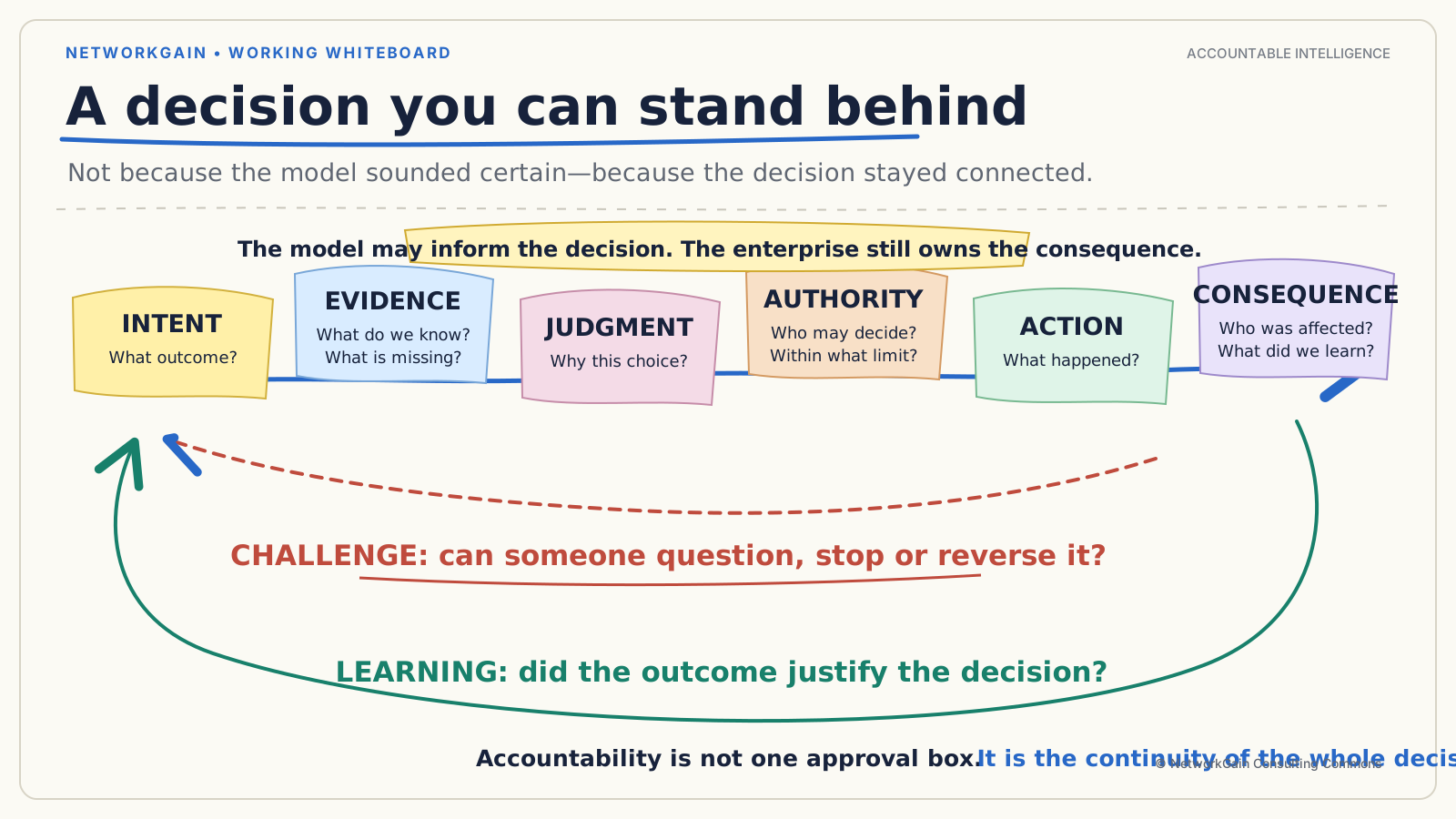
The decision spine
Every consequential AI-supported decision should preserve six connected elements. Together, they form what we call the decision spine.
1. Intent: what are we trying to achieve?
The system needs a legitimate and bounded purpose. “Improve efficiency” is too vague. “Reduce avoidable payment fraud without delaying legitimate suppliers beyond the agreed service level” is a decision frame.
Intent establishes the outcome, the people affected and the trade-offs the organisation is prepared to make. Without it, optimisation becomes detached from purpose.
2. Evidence: what do we know—and what do we not know?
The decision should reveal the material data, its provenance, freshness, permissions and limitations. Evidence also includes what is absent: missing documents, uncertain identity, incomplete history or an event outside the system’s experience.
Confidence is not a substitute for evidence quality.
3. Judgment: how was the evidence interpreted?
This is where models, policies, rules and human expertise meet. The decision record should identify the recommendation, relevant alternatives, material uncertainty and the factors that changed the conclusion.
Judgment does not require exposing proprietary model internals in every case. It requires an explanation appropriate to the consequence and the audience.
4. Authority: who may make this choice?
The ability to generate a recommendation does not grant permission to act on it. Authority should be explicit: which person or system may recommend, approve, execute, override or reverse the decision, under which conditions and within what limits?
Authority must travel with identity, scope, time and purpose. It should not exist as a broad technical permission waiting to be used.
5. Action: what happened?
The enterprise must connect the decision to the actual execution. Was a payment stopped, an applicant rejected, a machine shut down, an incident closed or a customer contacted? Were there partial failures, manual changes or downstream actions that altered the intended result?
A defensible recommendation followed by uncontrolled execution is not accountable intelligence.
6. Consequence: what did we learn?
Accountability continues after the decision. The organisation should observe whether the intended outcome occurred, who was affected, which exceptions emerged and whether correction or redress was needed.
This closes the learning loop. A decision system that records inputs but never studies consequences becomes auditable without becoming wiser.
If any link in this spine is missing, the enterprise may have an intelligent output but not an accountable decision.
Accountability must be proportional to consequence
Not every AI-supported choice needs the same ceremony.
A system suggesting a meeting time should not require the governance process used for a lending decision. Excessive controls on low-consequence work create friction without meaningful protection. Weak controls on high-consequence work create speed without legitimacy.
The right question is not simply, “Is a human in the loop?” It is, “What form of human and organisational control is proportionate to this consequence?”
Four levels are useful.
Assistive intelligence
AI organises information, drafts content or surfaces options. A person performs the decision and action. The emphasis is on provenance, quality and disclosure.
Recommendatory intelligence
AI proposes a course of action that materially influences a person. The reviewer needs alternatives, uncertainty, relevant policy and the practical ability to disagree. Overrides and decision outcomes should be studied.
Delegated intelligence
AI makes bounded decisions within pre-approved rules—for example, routing routine claims below a threshold. The enterprise needs clear authority, continuous monitoring, exception handling, reversibility and sampled human review.
Autonomous intelligence
AI can plan and execute across systems with limited intervention. The burden moves toward strict scopes, runtime controls, independent evaluation, stop mechanisms, incident response and strong evidence of ongoing fitness.
The level should be determined by consequence, reversibility, uncertainty and scale—not by how impressive the model appears.
The human problem inside “human oversight”
Accountable intelligence is frequently discussed as a control architecture. It is also a design problem for people.
Consider the manager facing the suspicious payment. If the system delivers a polished recommendation at the last possible moment, human oversight has already been weakened. If challenging the result requires navigating five applications, calling the data team and accepting responsibility for delay, the interface favours compliance. If overrides are questioned more aggressively than approvals, the culture has made the model the real authority.
Good oversight therefore requires more than an approval step.
The person must have:
- sufficient information to understand the decision;
- competence relevant to the consequence;
- time proportionate to the urgency and risk;
- authority to challenge, pause or reverse the action;
- protection from incentives that make disagreement unrealistic; and
- feedback about whether earlier decisions proved sound.
The NIST AI RMF Playbook recommends documenting the degree of human oversight, system overrides, errors, complaints, adjudication and accountable go/no-go decisions. That is important because oversight quality can be measured. Organisations should know whether people meaningfully intervene, mechanically approve or routinely compensate for system weakness outside the formal process.
A human in the loop should add judgment. They should not merely add a signature.
People affected by decisions need a route back in
Enterprise accountability is often designed from the perspective of the organisation: can we demonstrate compliance, reconstruct the incident and identify the owner?
The person affected asks a different set of questions.
Was AI involved? What materially shaped the outcome? Is the information about me accurate? Can I challenge it? Will a competent person reconsider the case? Can harm be corrected?
These questions turn accountability from internal documentation into practical recourse.
For consequential decisions, people should have five usable rights:
- Awareness: know when AI materially influenced the decision.
- Understanding: receive an explanation appropriate to the impact.
- Correction: challenge inaccurate or incomplete information.
- Review: obtain meaningful human reconsideration rather than automated repetition.
- Remedy: receive correction, restoration or escalation when the outcome was wrong or harmful.
An enterprise that can explain itself only to an auditor has built compliance evidence, not full accountability.
The operating implication
Accountable intelligence crosses the boundaries through which enterprises normally manage work.
The business owns the purpose and consequence. Technology owns system integrity and operation. Data leaders own provenance and permitted use. Risk and legal teams define boundaries. Model providers and implementation partners contribute components. Frontline users interpret exceptions. Senior leadership determines which trade-offs the organisation is willing to defend.
These responsibilities cannot remain adjacent. They must connect around the decision.
For every consequential AI system, four roles should be explicit:
- Decision owner: accountable for the business choice and its consequences.
- System owner: accountable for reliable operation, controls and change.
- Evidence owner: accountable for data provenance, quality and decision records.
- Challenge owner: empowered to test assumptions, represent affected interests and escalate concerns independently.
One person may hold more than one role in a smaller organisation. The distinction still matters. It prevents a technically successful implementation from becoming nobody’s decision.
The organisation also needs a durable decision record that is useful to operators, leaders and reviewers. At minimum it should connect:
- purpose and decision identifier;
- material inputs and their provenance;
- model, policy and system versions;
- recommendation, alternatives and uncertainty;
- human intervention and override;
- authority exercised;
- action taken and downstream status;
- observed consequence, challenge and remediation.
This record should be generated as the decision happens. Reconstructing it after harm is expensive and often impossible.
The NetworkGain view
The market frequently treats responsible AI as a collection of model controls: accuracy tests, bias checks, red teaming, guardrails and monitoring. These are necessary. They do not by themselves create accountable intelligence.
The unit that must be governed is the decision, not only the model.
That changes the starting point. Leaders should begin with the consequence they are willing to own, then design the evidence, judgment, authority, action and learning required to support it. Technology should fit that decision architecture—not define it by default.
NetworkGain can help leadership frame the consequential decisions, assign decision rights, establish proportionate assurance and connect AI governance to business outcomes. EnWithAI and the cohort ecosystem can translate that frame into working architecture: trusted context, bounded permissions, evaluations, traces, human handoffs, exception paths and evidence that survives delivery.
The aim is not to slow every decision. It is to make routine decisions safely faster and consequential decisions deliberately defensible.
What to do next
Choose one AI-supported decision that matters—not the entire AI estate.
Walk it from intent to consequence.
Ask:
- What outcome and trade-off is this decision designed to serve?
- Which evidence materially influences it, and where can that evidence fail?
- How are uncertainty and alternatives shown?
- Who may recommend, approve, execute, challenge and reverse it?
- Can an affected person obtain explanation, correction and review?
- Does the record connect the recommendation to the action actually taken?
- Do we observe the consequence and use it to improve the system?
The gaps will reveal more than another inventory of AI controls.
They will show where intelligence has outrun ownership.
The enterprise should never ask a person to stand behind a decision the system does not allow them to understand, challenge or change.
Accountable intelligence does not promise that every decision will be right. It ensures that every consequential decision can be understood, owned, corrected and made better the next time.