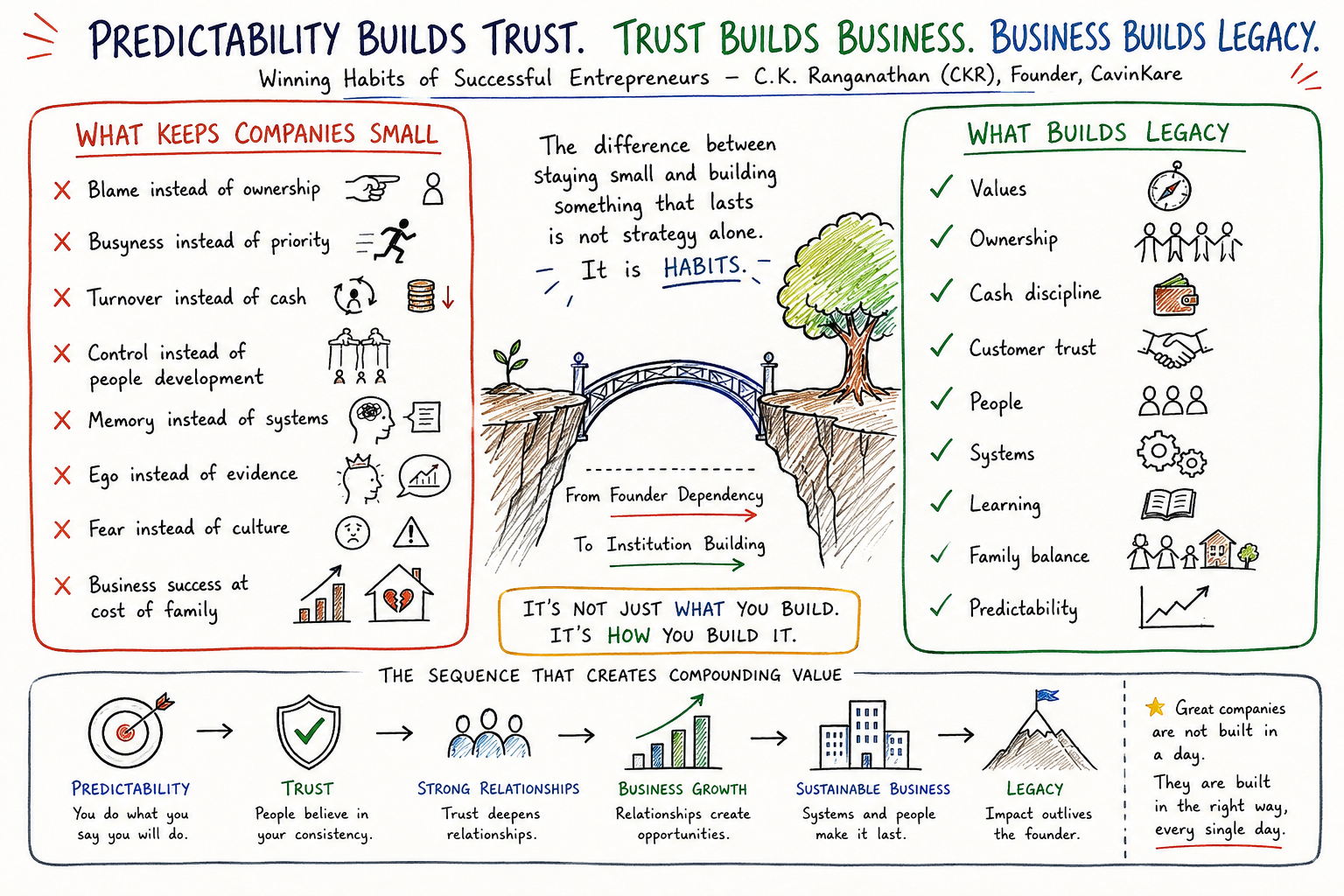
Recently, I came across a powerful slide attributed to C.K. Ranganathan (CKR), Founder of CavinKare, from his session on the winning habits of successful entrepreneurs.
The slide contrasted two lists. One described what keeps companies small. The other described what builds legacy.
The simplicity of the message is what makes it profound.
Because most businesses do not fail because of strategy.
Most businesses remain small because of habits.
What Keeps Companies Small
The list is uncomfortable because every founder has seen some version of it.
- Blame instead of ownership
- Busyness instead of priority
- Turnover instead of cash
- Control instead of people development
- Memory instead of systems
- Ego instead of evidence
- Fear instead of culture
- Business success at the cost of family
None of these appear catastrophic in isolation.
In fact, many growing companies accidentally celebrate them.
Busy teams are mistaken for productive teams. Revenue is celebrated while cash flow deteriorates. Founders become bottlenecks in the name of quality. Decisions remain trapped inside a few people’s heads.
Everything appears to work.
Until scale arrives.
Then the weaknesses become visible.
The Hidden Tax of Founder Dependency
Many businesses grow successfully from the energy, commitment, and judgment of a founder.
The challenge begins when growth depends on those same attributes forever.
If every decision requires founder intervention, growth slows.
If every customer depends on founder relationships, growth becomes fragile.
If every process depends on institutional memory, growth becomes risky.
The business starts carrying invisible operational debt.
The organization grows.
The operating model does not.
Eventually, complexity wins.
Not because the business lacks ambition.
Because the systems never matured beyond the founder.
What Builds Legacy
The opposite list is remarkably different.
- Values
- Ownership
- Cash discipline
- Customer trust
- People
- Systems
- Learning
- Family balance
- Predictability
Notice something important.
Almost none of these are growth hacks. Almost none of these are market strategies. Almost none of these are technology initiatives.
They are operating principles.
They are the foundations that allow businesses to scale without losing themselves.
Legacy is rarely built through extraordinary events. It is built through ordinary disciplines practiced consistently over time.
Why Predictability Matters More Than Growth
The most important insight on the slide appears at the bottom:
Predictability builds trust. Trust builds business. Business builds legacy.
This sequence deserves attention.
Many entrepreneurs focus on growth.
Customers focus on reliability.
Employees focus on consistency.
Investors focus on predictability.
Partners focus on trust.
The common denominator is not growth.
It is confidence.
People trust organizations that behave predictably.
Not because they are perfect.
Because they are dependable.
Predictability creates confidence.
Confidence creates trust.
Trust creates opportunity.
Opportunity compounds into business value.
Business value compounds into legacy.
The NetworkGain View
At NetworkGain, we often see organizations investing heavily in technology while underinvesting in operating discipline.
Technology can accelerate growth.
It cannot replace fundamentals.
Systems matter.
Governance matters.
Cash discipline matters.
People development matters.
Learning matters.
Culture matters.
Technology amplifies whatever already exists.
If the organization is disciplined, technology accelerates discipline.
If the organization is chaotic, technology accelerates chaos.
This is true for digital transformation.
It is true for AI.
It is true for business growth.
And it is true for entrepreneurship itself.
The companies that endure are not necessarily the fastest growing.
They are the most predictable.
Because predictable organizations earn trust.
And trust remains the most valuable business asset ever created.
A Final Thought
Every founder eventually faces a choice.
Build a business that depends on you.
Or build a business that survives because of what you built.
The first creates success.
The second creates legacy.
As CKR’s slide reminds us:
Predictability builds trust. Trust builds business. Business builds legacy.
And that may be one of the most important entrepreneurial lessons of all.
Attribution
This perspective was inspired by observations shared by C.K. Ranganathan (CKR), Founder of CavinKare, during his session on the winning habits of successful entrepreneurs. The interpretation, analysis, and conclusions presented here are NetworkGain’s editorial perspective.